


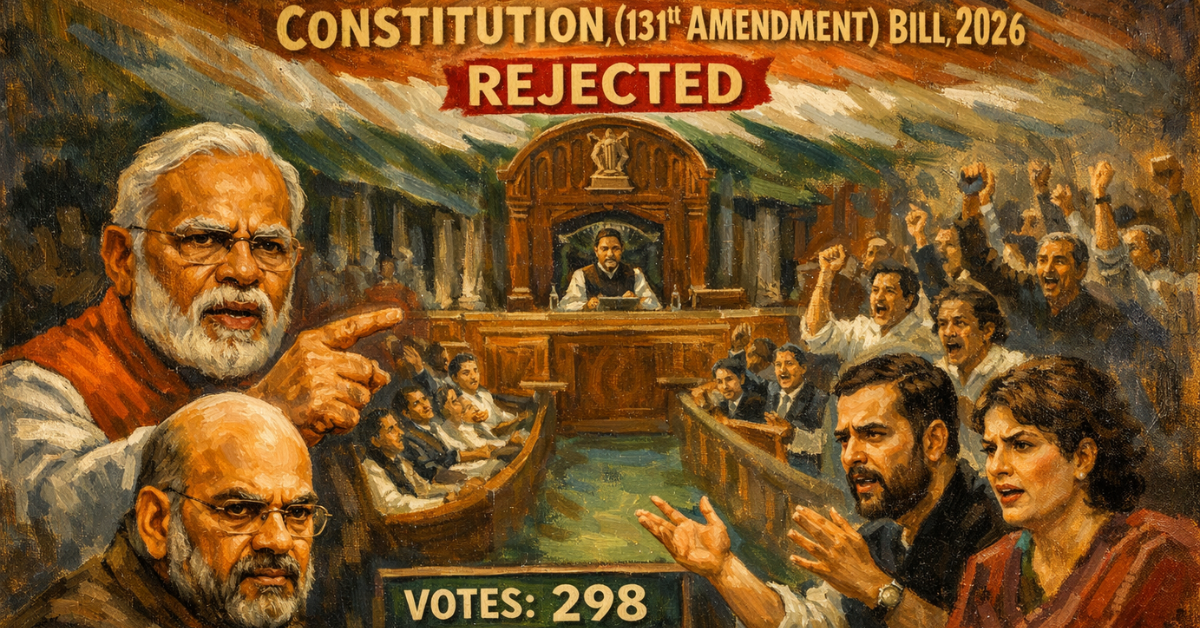
Lok Sabha Defeat of Constitution (131st Amendment) Bill
- The Constitution (131st Amendment) Bill, 2026 was defeated in the Lok Sabha on April 17, 2026, marking a rare legislative setback.
- The bill aimed to fast-track 33% women’s reservation by 2029 using the 2011 Census for delimitation.
- It proposed expanding Lok Sabha seats from 543 to around 850 and ending the decades-old seat freeze.
- The bill fell short of the required two-thirds majority by 54 votes.
- The debate has intensified political divisions over federal balance, representation, and electoral reforms.
On the evening of April 17, 2026, the Lok Sabha witnessed a rare and consequential legislative outcome. The Constitution (131st Amendment) Bill, 2026, introduced by the government to accelerate women’s reservation in Parliament, failed to secure the required special majority. The defeat has since triggered a sharp political confrontation across party lines, with both the ruling coalition and opposition claiming to represent the interests of women and federal balance.
The outcome carries historical weight. It marks the first instance since 2014 that a government-backed bill has been defeated in the Lok Sabha under the leadership of Prime Minister Narendra Modi. It is also the first failed constitutional amendment attempt in over a decade, recalling the last such setback in 2011. The implications extend beyond immediate legislative failure, reopening debates on representation, federalism, and electoral restructuring.
The Legislative Context: 2023 Law and the 2026 Proposal
The current debate cannot be understood without revisiting the earlier legislative framework. In September 2023, Parliament passed the landmark Nari Shakti Vandan Adhiniyam, a constitutional amendment that introduced a 33 percent reservation for women in the Lok Sabha and State Assemblies. The bill received near-unanimous political support and was widely presented as a milestone in India’s democratic evolution.
However, the law carried a critical condition. Its implementation was tied to two future exercises: a fresh population census and a delimitation process to redraw constituency boundaries. Given delays in conducting the census and the complexity of delimitation, the actual enforcement of women’s reservation was projected to take effect only after 2034.
The Constitution (131st Amendment) Bill, 2026 sought to address this delay. The government proposed delinking the reservation from the forthcoming census and instead using data from the 2011 Census to initiate delimitation immediately. This approach, according to the government, would make it feasible to implement the women’s quota in time for the 2029 general elections.
Structural Changes Proposed in the 131st Amendment
The proposed amendment was not limited to procedural acceleration. It involved substantial restructuring of India’s parliamentary system.
The most significant change was the proposed expansion of the Lok Sabha. The bill aimed to increase the total number of seats from the current 543 to a potential maximum of 850. This expansion was presented as a necessary adjustment to accommodate the 33 percent reservation for women without significantly reducing the number of general category seats available for contest.
Within this expanded framework, approximately 283 seats would have been reserved for women, ensuring compliance with the one-third quota. The government argued that this approach preserved competitive political space while fulfilling the objective of gender representation.
Another major provision was the removal of the decades-old freeze on seat reallocation among states. Since the 1970s, India has maintained a freeze on adjusting parliamentary seats based on population changes to avoid penalizing states that successfully controlled population growth. The 2026 bill proposed ending this freeze, allowing representation to be recalibrated according to demographic shifts reflected in the 2011 Census.
Voting Outcome and Parliamentary Arithmetic
As a constitutional amendment, the bill required a special majority, meaning it needed the support of at least two-thirds of members present and voting in the Lok Sabha.
- Total Members Voting: 528
- Votes Required for Passage: 352
- Votes in Favor: 298
- Votes Against: 230
The bill fell short by 54 votes, resulting in its formal rejection. Following the defeat, the government withdrew two associated pieces of legislation, namely the Delimitation Bill, 2026 and the Union Territories Laws (Amendment) Bill, 2026, both of which were integral to operationalizing the proposed changes.
Government’s Position: Accelerating Representation
In the immediate aftermath, senior leaders of the ruling coalition strongly criticized the opposition. Prime Minister Narendra Modi described the defeat as a missed opportunity for advancing women’s political representation. He argued that the government’s proposal was designed to ensure that women would not have to wait another decade for meaningful participation in legislative bodies.
Union Home Minister Amit Shah echoed similar sentiments, accusing opposition parties of obstructing a reform that had broad public support. The government maintained that expanding the Lok Sabha was the only mathematically viable method to implement a 33 percent quota without drastically reducing the number of unreserved seats.
From the government’s perspective, applying the quota within the existing 543-seat framework would have led to significant displacement of sitting constituencies and intensified competition for fewer open seats. The expansion model, therefore, was presented as a balanced solution that accommodated both reservation and representational continuity.
Opposition’s Counter-Argument: Process and Federal Balance
Opposition parties, however, framed their resistance around procedural integrity and federal concerns rather than opposition to women’s reservation itself.
Leaders including Rahul Gandhi and Priyanka Gandhi argued that the government had unnecessarily complicated the issue by linking reservation to delimitation. They questioned why the 33 percent quota could not be implemented immediately within the existing parliamentary structure.
Several opposition parties pointed to alternative legislative approaches. The Dravida Munnetra Kazhagam, for instance, proposed a private member’s bill to operationalize reservation within the current seat framework, avoiding the need for large-scale restructuring.
A central concern raised by opposition parties related to federal balance and the so-called “North-South divide.” Because the proposed delimitation would be based on population data from the 2011 Census, states with higher population growth, particularly in northern India, would gain a larger share of seats. In contrast, southern states, which have achieved lower population growth rates, would see their relative representation decline.
Opposition leaders described this as a structural imbalance that penalized states for successful population control policies. They argued that the proposal risked altering the federal equilibrium that has underpinned India’s parliamentary system for decades.
The Caste Census Dimension
Another layer of opposition emerged around the absence of updated caste data. Parties such as the Samajwadi Party and the Indian National Congress argued that proceeding with delimitation based on outdated census data would ignore evolving social realities, particularly concerning Other Backward Classes (OBCs).
They contended that without a comprehensive caste census, any redrawing of constituencies would risk entrenching existing disparities in representation. By locking in boundaries based on the 2011 Census, the system could remain misaligned with current demographic and social distributions for another decade or more.
This argument added a social justice dimension to the debate, linking women’s reservation with broader questions of inclusive representation.
Political Fallout and Intensifying Rhetoric
The days following the vote saw an escalation in political rhetoric. The ruling coalition accused opposition parties of hypocrisy, pointing to their earlier support for the 2023 law. Opposition leaders, in turn, accused the government of attempting to push through a complex constitutional change without adequate consultation.
Public discourse reflected this polarization. While some commentators viewed the defeat as a setback for gender representation, others framed it as a necessary check on rapid institutional restructuring.
The debate has also exposed deeper tensions within India’s political system. Questions about the balance between central authority and state representation, the role of demographic data in electoral design, and the sequencing of reforms have all come to the forefront.
Historical Significance of the Defeat
Legislative defeats of this nature are rare in India’s recent parliamentary history. Since 2014, the government has maintained a strong legislative record, with most bills passing through Parliament with relative ease.
The rejection of the Constitution (131st Amendment) Bill therefore signals a moment of institutional assertion by the opposition. It demonstrates that constitutional amendments, which require broader consensus, remain subject to rigorous scrutiny and cannot be secured through simple majority strength alone.
The last comparable instance of a constitutional amendment failing dates back to 2011, making this event a notable point in legislative history.
Implications for Women’s Reservation
With the failure of the 2026 amendment, the original framework established by the Nari Shakti Vandan Adhiniyam remains in place. This means that the implementation of women’s reservation continues to depend on the completion of a new census and a subsequent delimitation exercise.
Given current timelines, this effectively postpones the realization of the 33 percent quota until the early 2030s. The delay raises questions about political commitment and administrative readiness, especially in light of the near-unanimous support the 2023 law received.
At the same time, the debate has kept the issue of women’s representation at the center of national politics. Both the government and opposition have reaffirmed their support for the principle of reservation, even as they differ sharply on the method of implementation.
The Road Ahead: Policy and Political Options
The government retains the option of introducing a revised proposal that addresses opposition concerns. One possible approach would be to design a framework that implements reservation within the existing Lok Sabha structure, at least as an interim measure.
Alternatively, the government could seek broader consensus on delimitation by incorporating updated demographic data and addressing federal concerns more explicitly. This would require coordination with states and potentially a re-evaluation of the timeline for census and electoral reforms.
For the opposition, the challenge lies in translating its critique into a coherent legislative alternative. While calls for immediate implementation within the current framework have gained traction, the practical complexities of such an approach remain to be fully articulated.
Broader Democratic Context
The events of April 2026 highlight the complexity of institutional reform in a diverse and federal polity like India. Efforts to expand representation, whether based on gender or population, intersect with deeply rooted political, regional, and social considerations.
The debate also reflects a broader tension between urgency and consensus. While there is widespread agreement on the need to enhance women’s participation in politics, there is less agreement on how quickly and through what mechanisms such change should occur.
In this context, the defeat of the Constitution (131st Amendment) Bill may be seen not only as a legislative setback but also as part of an ongoing process of negotiation within India’s democratic framework.
Continuing Debate on Representation and Reform
As political parties reassess their positions, the question of women’s reservation is likely to remain a central issue in the run-up to future elections. The outcome of this debate will depend not only on legislative strategy but also on public opinion and electoral dynamics.
The April 2026 confrontation has clarified the stakes involved. It has shown that while there is consensus on the goal of greater representation, the path to achieving it remains contested. The coming years will determine whether a middle ground can be found that balances speed, fairness, and federal equity within India’s evolving parliamentary system.