


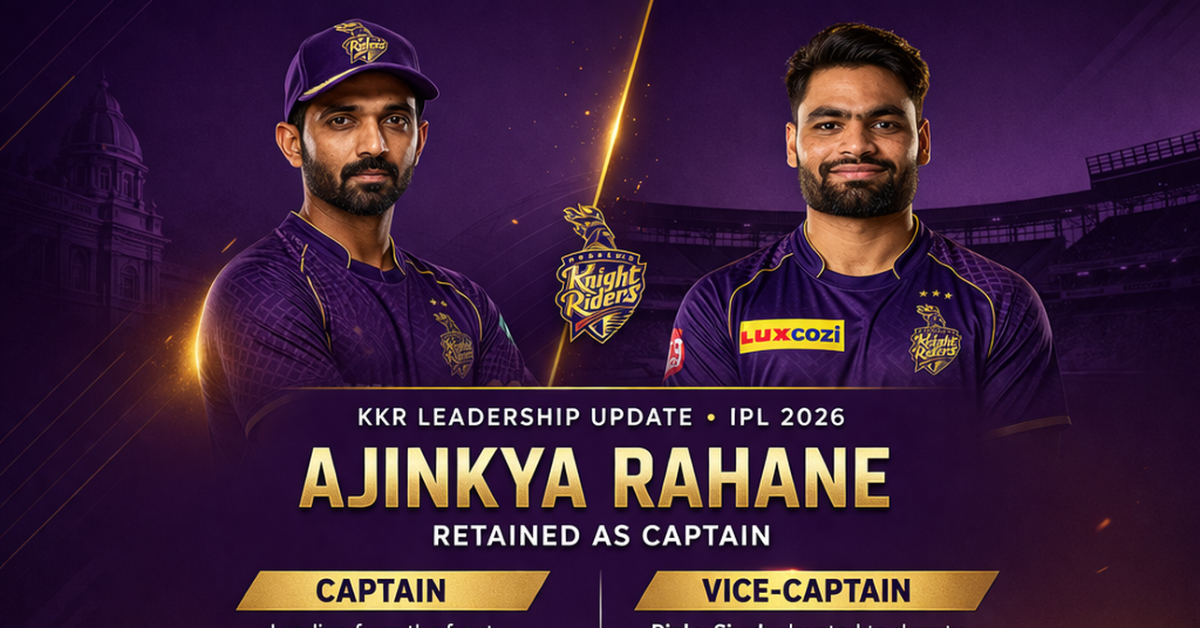
KKR Reshapes Leadership Core Ahead of IPL 2026 Season
- Ajinkya Rahane confirmed as captain despite a difficult 2025 campaign.
- Rinku Singh elevated to vice-captain, marking a strategic leadership transition.
- Announcement made at Knights Unplugged 3.0 event in Kolkata on March 24, 2026.
- Move signals long-term succession planning within the franchise leadership.
- KKR set to begin IPL 2026 campaign against Mumbai Indians on March 29 at Wankhede Stadium.
As the Indian Premier League approaches its 2026 season, the Kolkata Knight Riders have formalised a leadership structure that blends continuity with transition. The franchise confirmed that Ajinkya Rahane will continue as captain, while Rinku Singh has been appointed vice-captain. The announcement, made on March 24 during a team event at Eden Gardens, reflects a calibrated approach that seeks stability at the top while preparing for the future.
Leadership Reset Announced at Eden Gardens
The development was formally communicated during the “Knights Unplugged 3.0” event held at Eden Gardens, where team management addressed players, media, and fans. KKR CEO Venky Mysore confirmed that Rinku Singh would take on the vice-captaincy role, positioning him as second-in-command under Rahane.
The event, which has become a recurring pre-season platform for internal announcements and fan engagement, served as a stage to signal both reassurance and change. While Rahane’s continuation underscores management’s belief in experience, the elevation of Rinku indicates a shift toward grooming internal leadership assets.
KKR’s decision comes at a time when IPL franchises increasingly emphasise leadership continuity alongside succession planning, especially in a league where team compositions change frequently due to auctions and transfers.
Rahane Retained Despite 2025 Setback
Rahane’s reappointment as captain follows a season in which KKR finished eighth in the standings, a result that drew scrutiny from analysts and supporters. Despite the outcome, the management has chosen to retain him, citing his composure, tactical awareness, and dressing room influence.
Statistically, Rahane remained one of the few consistent performers for KKR in 2025. He emerged as the team’s leading run-scorer with 390 runs, providing stability in an otherwise fluctuating batting order. His ability to anchor innings while adapting to T20 demands has been central to the team’s batting approach.
In the lead-up to the 2026 season, Rahane has also shown signs of form. During a pre-season intra-squad practice match, he scored a brisk 58 off 25 balls, an innings that has been interpreted within the camp as a response to external criticism regarding his strike rate and role in the format.
From a leadership standpoint, Rahane brings prior captaincy experience at both domestic and international levels. His tenure as India’s Test captain, though intermittent, has been associated with disciplined team structures and calm decision-making under pressure.
Rinku Singh’s Elevation Signals Long-Term Planning
The appointment of Rinku Singh as vice-captain marks a notable shift in KKR’s internal hierarchy. Having been part of the franchise since 2018, Rinku’s journey from a developing player to a central figure in the team has been gradual but consistent.
He replaces Venkatesh Iyer in the leadership group after Iyer’s release from the squad and subsequent move to Royal Challengers Bengaluru. The transition reflects both a change in personnel and a recalibration of leadership priorities.
Rinku’s recent international success has added weight to his profile. As part of India’s squad in the ICC Men’s T20 World Cup, he has gained exposure to high-pressure environments and strategic decision-making at the highest level. Within KKR, his role as a finisher has already established him as a player capable of influencing outcomes in critical moments.
The vice-captaincy is therefore seen not merely as recognition, but as preparation. By placing Rinku in a leadership position alongside Rahane, the franchise appears to be creating a pathway for eventual succession without disrupting the current structure.
Strategic Balance Between Experience and Transition
The dual leadership model adopted by KKR reflects a broader trend within franchise cricket, where teams seek to balance immediate competitiveness with future planning. Rahane’s presence offers tactical stability and experience, while Rinku’s elevation introduces energy and continuity.
According to team insiders, this structure is intended to distribute responsibilities more evenly within the squad. While Rahane will continue to lead on-field decisions, Rinku is expected to play a larger role in team discussions, player coordination, and match situational inputs.
Head coach Abhishek Nayar indicated during the event that the timing of Rinku’s promotion aligns with his growth trajectory. He described the move as a natural progression given Rinku’s development over recent seasons.
Dressing Room Dynamics and Leadership Perception
Rahane’s response to the appointment was measured and supportive. He acknowledged Rinku’s importance within the team and noted his growing influence both on and off the field. In his remarks, Rahane emphasised that leadership in T20 cricket extends beyond formal titles, involving contributions from multiple players in high-pressure situations.
He also observed that after team owner Shah Rukh Khan, Rinku Singh is among the most recognisable figures associated with KKR. The comment reflects not only Rinku’s cricketing contributions but also his connection with the fan base.
Within the dressing room, the move is understood to have been received positively. Younger players, in particular, are expected to benefit from a leadership group that combines experience with relatability.
Fan Sentiment and Public Reaction
The announcement generated a strong reaction from supporters present at Eden Gardens. Chants of “Captain kore dao Rinku” were heard during the event, indicating a section of the fan base that already views Rinku as a future captain.
Such reactions are not unusual in franchise cricket, where fan attachment often influences narratives around leadership. Rinku’s rise from a relatively unknown domestic player to a match-winner and now a national representative has resonated with supporters.
However, the management’s decision to retain Rahane suggests a preference for gradual transition rather than immediate change. This approach allows the team to maintain stability while accommodating fan expectations over time.
Context Within IPL Leadership Trends
KKR’s leadership restructuring can also be viewed within the wider context of IPL team strategies. In recent seasons, franchises have increasingly prioritised continuity in leadership to build coherent team identities.
Frequent captaincy changes have often been linked to inconsistent performances, prompting teams to invest in long-term leadership frameworks. By pairing Rahane with Rinku, KKR appears to be aligning with this trend.
Additionally, the move reflects an understanding of the evolving demands of T20 cricket, where leadership requires adaptability, quick decision-making, and strong communication across diverse squads.
Season Opener and Immediate Challenges
KKR will begin their IPL 2026 campaign against Mumbai Indians on March 29 at the Wankhede Stadium. The opening fixture presents an early test for the new leadership combination.
Mumbai Indians, traditionally one of the strongest teams in the league, will provide a benchmark for assessing KKR’s preparedness and tactical clarity. For Rahane and Rinku, the match will offer an opportunity to demonstrate how their partnership functions under competitive conditions.
Key challenges for KKR include stabilising their batting order, improving middle-over acceleration, and addressing bowling inconsistencies that affected their 2025 campaign.
What This Means for KKR’s 2026 Campaign
The leadership decisions taken ahead of IPL 2026 indicate that KKR is not pursuing abrupt change but rather a structured transition. By retaining Rahane, the franchise signals confidence in experience and composure. By promoting Rinku, it acknowledges the need to invest in future leadership.
The effectiveness of this approach will depend on how well the roles are defined and executed during the season. Clear communication, shared responsibility, and adaptability will be critical factors.
As the tournament begins, attention will not only be on results but also on how this leadership model shapes team culture, decision-making, and performance under pressure.