


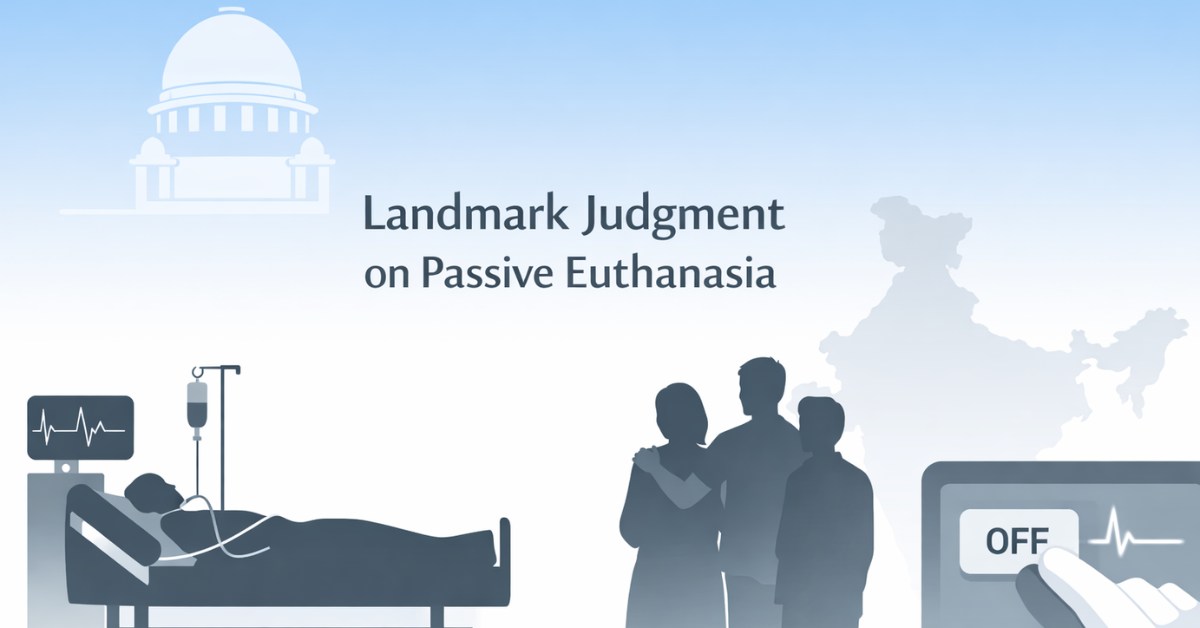
India’s Passive Euthanasia Framework Applied
- The Supreme Court on 11 March 2026 allowed withdrawal of life-sustaining treatment for Harish Rana, who has been in a permanent vegetative state for more than 13 years.
- The court ruled that artificial nutrition and hydration provided through a PEG feeding tube qualifies as medical treatment and may be withdrawn under passive euthanasia guidelines.
- The judgment applies and clarifies the constitutional framework laid down in the Common Cause rulings of 2018 and 2023.
- Medical boards confirmed Rana has irreversible brain damage and no realistic chance of recovery.
- The court emphasized the constitutional principle that the right to live with dignity under Article 21 includes the right to die with dignity.
The Supreme Court of India has delivered a significant ruling on end-of-life rights, permitting the withdrawal of life-sustaining medical treatment for Harish Rana, a man who has remained in a permanent vegetative state for over thirteen years following a traumatic brain injury.
The judgment, delivered on 11 March 2026 by a bench led by Justice J. B. Pardiwala, is being regarded as one of the most detailed applications of India’s passive euthanasia framework since the landmark Constitution Bench ruling in Common Cause v. Union of India (2018). The court held that continued artificial life support in Rana’s case served no therapeutic purpose and that allowing nature to take its course would be consistent with the constitutional right to die with dignity.
Background: Accident That Changed a Young Life
Harish Rana, now 32, was a B.Tech student at Punjab University when he suffered a catastrophic accident on 20 August 2013. According to records presented before the court, Rana fell from the fourth floor of his paying guest accommodation and sustained severe traumatic brain injuries known as diffuse axonal injury.
He was first taken to a local hospital and then shifted to the Postgraduate Institute of Medical Education and Research in Chandigarh because of the severity of his condition. Doctors administered ventilatory support, tracheostomy, antibiotics and feeding through a nasogastric tube.
Although Rana survived the initial trauma, his neurological condition never improved. Over time he was diagnosed as being in a permanent vegetative state with quadriplegia and complete sensorimotor dysfunction. Medical disability certificates issued by government hospitals recorded that he had suffered 100 percent permanent disability.
Since the accident, Rana has remained completely dependent on medical support for survival. Artificial nutrition and hydration are provided through a surgically placed feeding tube known as a Percutaneous Endoscopic Gastrostomy or PEG tube. He also requires tracheostomy support for breathing and continuous nursing care.
Years of Medical Treatment With No Recovery
Medical reports examined by the court revealed that Rana has no awareness of his surroundings and is incapable of communication or voluntary movement. His eyes open and close naturally, but he does not respond to sound, touch, or pain stimuli.
Over the years he has suffered repeated infections, seizures and severe bedsores due to prolonged immobility. Despite extensive treatment, including advanced therapies attempted by doctors, his neurological condition has remained unchanged for more than a decade.
The court noted that Rana has been cared for primarily at home by his parents with periodic hospital visits whenever medical complications arise.
The Family’s Appeal to the Court
After more than thirteen years of caring for their son, Rana’s parents approached the judiciary seeking permission to withdraw artificial feeding and life support.
They told the court that their son cannot speak, see, hear or recognise anyone and has remained entirely dependent on medical devices. According to them, continuing treatment has not improved his condition and only prolongs an irreversible state.
The family explained that they had taken the decision after years of medical consultations and emotional struggle. They argued that allowing their son to pass away peacefully would preserve his dignity rather than forcing him to remain indefinitely in a vegetative state.
Earlier Proceedings in the Delhi High Court
The case first reached the Delhi High Court in 2024 through a writ petition seeking medical evaluation under passive euthanasia guidelines. However, the High Court dismissed the petition.
The High Court reasoned that Rana was not being kept alive through mechanical ventilation and therefore did not fall within circumstances that required judicial intervention.
Following that decision, Rana’s parents approached the Supreme Court through a Special Leave Petition. The Supreme Court disposed of the petition while granting liberty to the family to seek further directions if necessary.
When Rana’s medical condition remained unchanged, the family filed a Miscellaneous Application in the Supreme Court in 2025, leading to the present judgment.
Medical Boards Examined the Patient
To determine the medical facts independently, the Supreme Court ordered the formation of two separate medical boards.
Primary Medical Board
A primary board consisting of neurologists, neurosurgeons and critical care specialists examined Rana at his residence. The doctors confirmed that he remained in a vegetative state and required continuous external support for feeding and basic bodily functions.
The board concluded that the possibility of neurological recovery was negligible.
Secondary Medical Board at AIIMS
The court then directed the All India Institute of Medical Sciences in New Delhi to constitute a second medical board. This board included specialists in neurology, psychiatry, neurosurgery and anaesthesia.
After detailed clinical examination, the board reported that Rana had irreversible brain damage caused by severe traumatic injury. Doctors confirmed that artificial nutrition and hydration were necessary only to sustain survival but would not improve the underlying medical condition.
Key Legal Questions Before the Supreme Court
The judgment addressed several important questions relating to end-of-life care in India.
- Whether artificial nutrition and hydration through a feeding tube constitutes medical treatment.
- Whether such treatment can legally be withdrawn when recovery is medically impossible.
- How courts should apply the passive euthanasia guidelines laid down in earlier constitutional judgments.
- What safeguards must exist before life-sustaining treatment is discontinued.
Passive Euthanasia Versus Active Euthanasia
The court revisited the distinction between active and passive euthanasia, which has long been debated in medical ethics and constitutional law.
Active euthanasia refers to a deliberate act intended to cause death, such as administering a lethal injection. This form of euthanasia remains illegal under Indian law.
Passive euthanasia, on the other hand, refers to the withdrawal or withholding of medical treatment that artificially prolongs life. In such situations, death occurs due to the underlying illness rather than a direct medical intervention.
The court explained that removing life-supporting medical treatment allows the patient’s medical condition to follow its natural course rather than introducing a new cause of death.
Constitutional Principle: Right to Die With Dignity
The judgment relied heavily on Article 21 of the Constitution, which guarantees the right to life and personal liberty.
Previous Supreme Court decisions have interpreted this right to include living with dignity rather than mere biological survival. In the landmark Common Cause ruling of 2018, the Constitution Bench held that the right to live with dignity includes the right to die with dignity in cases involving terminal illness or irreversible medical conditions.
The present judgment reaffirmed that principle, stating that continuing futile medical treatment which only prolongs suffering may violate the dignity that Article 21 seeks to protect.
The “Best Interest of the Patient” Test
The court applied the legal principle known as the “best interest of the patient” standard. This requires decision-makers to examine whether continued treatment serves any meaningful purpose.
In assessing best interest, courts consider medical evidence, quality of life, likelihood of recovery and the views of family members responsible for care.
In Rana’s case, both medical boards concluded that his condition was irreversible and that continued artificial feeding would not restore consciousness or neurological function.
The Supreme Court’s Final Decision
After reviewing medical evidence and legal principles, the Supreme Court concluded that continued life-sustaining treatment in Rana’s case was medically futile.
The court therefore permitted withdrawal of clinically assisted nutrition and hydration administered through the PEG tube, subject to strict medical supervision and appropriate palliative care.
Doctors were directed to ensure that the process is carried out in a humane and dignified manner, with adequate comfort care for the patient.
Why the Judgment Matters
Legal experts say the ruling provides significant clarity on India’s passive euthanasia framework.
The court confirmed that artificial feeding through medical devices is a form of medical treatment and may be withdrawn under appropriate circumstances. The judgment also simplifies procedural safeguards for doctors and hospitals when dealing with similar cases.
Importantly, the court once again urged Parliament to enact a comprehensive law governing end-of-life medical decisions, noting that the current framework relies largely on judicial guidelines.
The case also highlights the human dimension behind such legal debates. Rana’s parents told the court they were not abandoning their son but seeking a dignified end after more than thirteen years of continuous care and emotional struggle.