


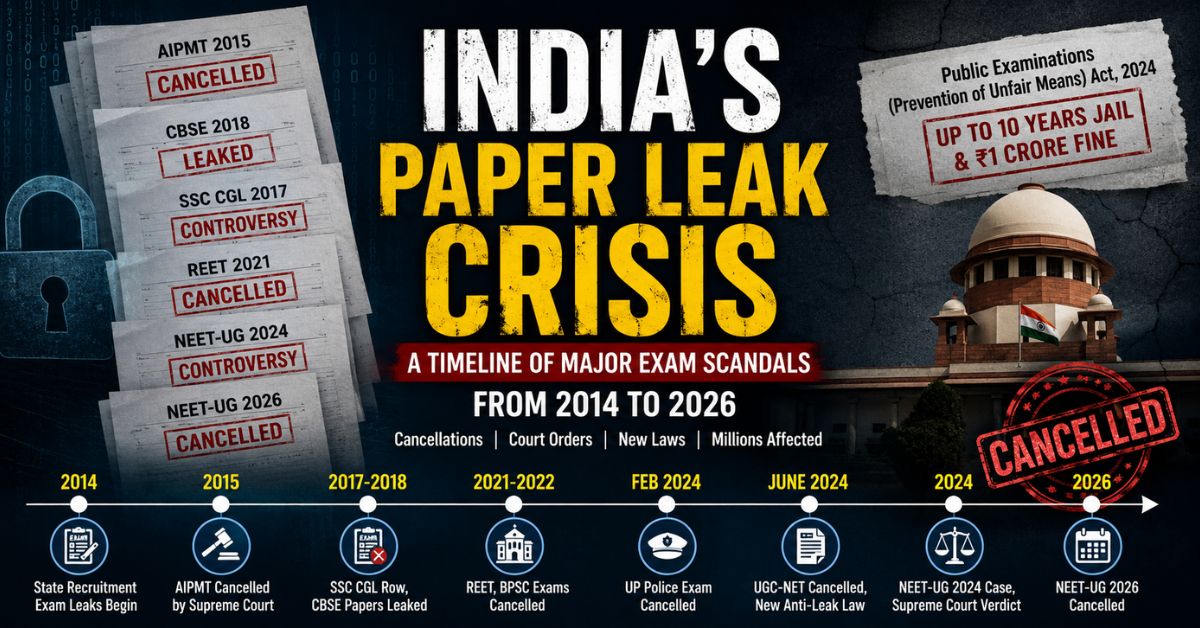
India’s Paper Leak Crisis: Key Highlights
- India has witnessed repeated paper leak scandals affecting national and state-level examinations over the past decade.
- Several high-profile exams, including AIPMT, CBSE Board Exams, SSC CGL, UGC-NET, NEET-UG, REET, and major state recruitment tests, have been cancelled or re-conducted following allegations or confirmed evidence of question paper leaks.
- The Union government enacted the Public Examinations (Prevention of Unfair Means) Act, 2024, introducing stringent penalties for organized examination fraud.
- Despite stronger laws and tighter security measures, recent incidents indicate that examination integrity remains a significant challenge.
For millions of students across India, competitive examinations represent years of preparation and often determine access to higher education or government employment. When examination papers are leaked before candidates enter the examination hall, the consequences extend far beyond a single test. Candidates lose months or years of preparation, governments face pressure to restore public confidence, and investigating agencies are tasked with uncovering organized networks behind the leaks.
Over the past decade, India has experienced repeated incidents involving national entrance examinations, teacher eligibility tests, recruitment examinations and school board papers. Some cases resulted in nationwide re-examinations ordered by governments or courts, while others triggered investigations by the Central Bureau of Investigation (CBI), state police Special Investigation Teams (SITs), or judicial scrutiny.
Although individual cases differ in scale and method, many have raised similar questions about examination security, institutional accountability and the growing sophistication of criminal networks seeking to exploit high-stakes recruitment and admission processes.
The issue has gained renewed attention following multiple high-profile examination controversies in recent years, prompting Parliament to enact the Public Examinations (Prevention of Unfair Means) Act, 2024. The legislation introduced some of the country’s toughest penalties against organized examination fraud, including imprisonment of up to ten years and fines of up to ₹1 crore for certain offences involving public examinations.
Yet even after the law came into force, fresh cases have continued to emerge, highlighting that stronger legal provisions alone may not eliminate the problem without effective enforcement, secure examination systems and coordinated investigations.
Why Paper Leaks Matter
India conducts thousands of competitive examinations every year across central ministries, state governments, universities and recruitment agencies. Many of these examinations attract hundreds of thousands or even millions of applicants competing for a relatively small number of seats or jobs.
Medical entrance examinations determine admissions to MBBS and other health science courses. Teacher eligibility tests influence recruitment into government schools. Police recruitment examinations decide entry into state police forces, while public service commission examinations open pathways into administrative services.
Because of this intense competition, examination integrity is essential. When question papers are compromised before an examination begins, authorities often face difficult choices.
They may proceed with the examination while investigating whether the breach was localized, or they may cancel the examination entirely if officials conclude that its integrity has been substantially affected.
The decision can have significant consequences. Re-examinations involve additional public expenditure, logistical challenges, revised admission schedules and prolonged uncertainty for candidates.
Students who have spent months preparing for an examination frequently have to repeat the entire process, while institutions must reorganize counselling, recruitment or admission timelines.
A Decade of Repeated Incidents
Although isolated paper leak incidents have occurred for decades, the period beginning around 2014 saw several high-profile cases involving both state and national examinations.
Some incidents remained limited to individual states, while others affected candidates across the country.
Investigations over the years have involved allegations of insiders accessing confidential papers before examinations, organized criminal networks distributing question papers through digital messaging platforms, impersonation rackets, and manipulation of examination processes. The specific facts vary from case to case, and investigators have not attributed every incident to the same methods or organizations.
Several investigations have also resulted in arrests of middlemen, examination officials, printing personnel and candidates, depending on the circumstances of each case. However, many cases have continued through lengthy investigations and court proceedings, meaning not every allegation has resulted in convictions.
The First Major National Turning Point
One of the most significant milestones came in 2015, when the All India Pre-Medical Test (AIPMT) was cancelled after investigators uncovered evidence of organized cheating involving electronic transmission of question papers.
The Supreme Court ordered a fresh examination after hearing the matter, making it one of the first instances in which India’s highest court directed the cancellation of a nationwide medical entrance examination because its integrity had been compromised.
The judgment established an important precedent by emphasizing that fairness to honest candidates must remain central to any examination process.
The case also demonstrated that organized examination fraud could extend across multiple states rather than remaining confined to isolated local incidents.
Growing Public Attention
Over the following years, examination integrity became a matter of increasing public concern.
In 2017, allegations surrounding the Staff Selection Commission Combined Graduate Level (SSC CGL) examination triggered widespread protests by candidates in New Delhi and other cities.
Candidates demanded an independent investigation into alleged irregularities in the computer-based examination process. The controversy eventually reached the Supreme Court, while the government ordered a CBI inquiry into the allegations.
Although the controversy differed from traditional paper leak cases because it also involved concerns about computer-based testing, it highlighted growing public anxiety over recruitment examinations conducted on a national scale.
The following year, another major controversy emerged when question papers for the Central Board of Secondary Education (CBSE) examinations became the subject of leak allegations.
The Class XII Economics examination was conducted again after the government confirmed that its integrity had been compromised. The Class X Mathematics examination also came under scrutiny, although authorities later decided against conducting a nationwide re-examination after reviewing the available evidence.
The CBSE episode demonstrated that paper leak concerns were no longer limited to recruitment examinations or professional entrance tests. School students preparing for board examinations also found themselves affected by failures in examination security.
State-Level Recruitment Exams Also Under Pressure
While national examinations attracted widespread media attention, several state governments simultaneously dealt with recurring challenges involving recruitment examinations.
One of the earliest examples during this period involved recruitment examinations conducted in Gujarat, including the GPSC Chief Officer examination and Talati recruitment examinations, which became the subject of investigations following reports of leaked question papers.
Rajasthan later faced one of its biggest recruitment controversies through the Rajasthan Eligibility Examination for Teachers (REET).
The Level-2 REET examination conducted in 2021 was eventually cancelled after investigators uncovered evidence suggesting that confidential examination papers had been leaked before the test. The case led to arrests, departmental action against officials and investigations into organized networks allegedly involved in the leak.
Similarly, the Bihar Public Service Commission cancelled its 67th Combined Preliminary Examination in 2022 after question papers were reported to have circulated before the examination concluded.
These incidents reinforced concerns that examination fraud was affecting recruitment processes across multiple states rather than remaining confined to isolated regions.
By the early 2020s, repeated examination controversies had increased pressure on both state governments and the Union government to strengthen legal safeguards, improve examination security and accelerate investigations into organized cheating networks.
The debate would intensify further in 2024, when multiple high-profile examination controversies unfolded within a matter of months, bringing the issue of paper leaks to the center of national discussion.
From State Recruitment Scandals to a National Challenge
The years between 2023 and 2026 marked one of the most closely watched periods for examination integrity in India. Several major examinations were either cancelled, postponed or investigated after allegations or evidence of paper leaks emerged. While each case had its own circumstances, together they intensified public scrutiny of examination agencies and prompted governments to strengthen legal and administrative safeguards.
Major Paper Leak Timeline (2014–2026)
| Event | Date |
|---|---|
| GPSC Chief Officer Recruitment Paper Leak (Gujarat) | 2014 |
| Talati Recruitment Leak (Gujarat) | 2015 |
| AIPMT Cancelled by Supreme Court | 2015 |
| Vyapam Investigation Expanded; CBI Took Over Probe | 2015–2016 |
| SSC CGL Examination Controversy | 2017 |
| CBSE Class XII Economics Re-Exam | 2018 |
| CBSE Class X Mathematics Leak Investigation | 2018 |
| REET Level-2 Examination Cancelled | 2021 |
| BPSC 67th Combined Preliminary Examination Cancelled | 2022 |
| UP Police Constable Recruitment Examination Cancelled | February 2024 |
| Public Examinations (Prevention of Unfair Means) Act Passed | February 2024 |
| Public Examinations Act Came Into Force | June 2024 |
| UGC-NET Examination Cancelled | June 2024 |
| NEET-UG 2024 Controversy and Supreme Court Judgment | 2024 |
| Examination Security Reforms by NTA | 2025 |
| NEET-UG 2026 Cancelled and Re-Examination Announced | 2026 |
| Maharashtra Teacher Eligibility Test Postponed | 2026 |
2014: Gujarat Recruitment Examination Under Scrutiny
One of the earliest widely reported recruitment controversies during this period involved the Gujarat Public Service Commission (GPSC) Chief Officer recruitment examination in 2014.
Authorities investigated allegations that the examination paper had been leaked before candidates appeared for the test. The case became one of several recruitment controversies that later shaped public debate about examination security in Gujarat.
Although the scale of the incident was considerably smaller than later national-level controversies, it demonstrated how recruitment examinations for government jobs had become attractive targets for organized cheating networks.
2015: AIPMT Cancellation Sets a National Precedent
The biggest examination controversy of 2015 involved the All India Pre-Medical Test (AIPMT), the national medical entrance examination that preceded NEET.
Investigators uncovered evidence that an organized racket had allegedly transmitted answers electronically to candidates during the examination. The matter quickly reached the Supreme Court.
After reviewing the evidence, the Supreme Court cancelled the examination and directed that a fresh test be conducted for all candidates.
The decision affected hundreds of thousands of students across the country and established an important legal principle. The Court held that maintaining the integrity of a national examination was more important than preserving an examination that had been compromised.
The AIPMT judgment continues to be cited whenever courts examine requests for cancellation of major entrance examinations.
2015–2016: Vyapam Investigation Continues
During the same period, investigations into the Madhya Pradesh Professional Examination Board, commonly known as the Vyapam scam, continued to expand.
Unlike a single paper leak case, the Vyapam investigation covered multiple recruitment examinations and professional admission tests conducted over several years.
Investigators alleged widespread irregularities including impersonation, manipulation of examination records and organized fraud involving candidates, middlemen and public officials.
Because of the scale and complexity of the investigation, the Supreme Court transferred the probe to the Central Bureau of Investigation in 2015.
The CBI subsequently investigated hundreds of related cases. Several accused were prosecuted, while court proceedings in many cases continued over subsequent years.
Legal experts often distinguish the Vyapam case from conventional paper leak incidents because it involved multiple forms of examination fraud rather than only unauthorized disclosure of question papers.
Nevertheless, the scandal remains one of the most significant examination integrity crises in India’s history.
2017: SSC CGL Protests Draw National Attention
In 2017, the Staff Selection Commission Combined Graduate Level (SSC CGL) examination became the focus of nationwide protests.
Candidates alleged irregularities in the computer-based examination process and demanded an independent investigation.
Thousands of aspirants gathered outside the Staff Selection Commission headquarters in New Delhi, arguing that confidence in the recruitment process had been undermined.
The government later ordered a CBI inquiry into the allegations.
The matter also reached the Supreme Court through multiple petitions filed by candidates seeking judicial intervention.
Unlike AIPMT, the SSC controversy did not result in cancellation of the entire recruitment process. Instead, authorities adopted corrective measures for affected examinations while investigations continued.
The episode demonstrated that examination integrity concerns were no longer limited to traditional paper-based examinations.
Computer-based recruitment tests also faced allegations relating to security and transparency.
2018: CBSE Board Examination Leak
Another major controversy emerged in 2018 when question papers for CBSE Board examinations were circulated before the scheduled examinations.
The Class XII Economics paper was confirmed to have been compromised.
The Union government subsequently announced that the examination would be conducted again.
The Class X Mathematics paper also became the subject of leak allegations.
Initially, authorities considered holding another examination. However, after assessing the available evidence and its impact, the government decided not to conduct a nationwide re-examination for Class X Mathematics.
The incident generated widespread concern because it affected school students rather than candidates appearing for competitive recruitment examinations.
Parents, teachers and education experts questioned whether existing examination security systems were adequate for examinations conducted on such a large scale.
2018–2023: Repeated State-Level Recruitment Controversies
Over the next several years, multiple states reported examination-related controversies involving recruitment tests.
Gujarat witnessed investigations involving teacher recruitment examinations and other state recruitment processes.
Several cases resulted in arrests of suspects accused of participating in leak networks.
Authorities also introduced additional security measures, including stronger monitoring of printing facilities, transportation of confidential examination papers and tighter control over examination centres.
Although these reforms aimed to reduce vulnerabilities, isolated incidents continued to be reported across different states.
2021: REET Examination Cancelled
The Rajasthan Eligibility Examination for Teachers (REET) became one of the largest state-level examination controversies in recent years.
Investigators alleged that confidential examination papers had been leaked before the Level-2 examination.
Following the investigation, the Rajasthan government cancelled the examination.
Special Investigation Teams arrested several suspects, including individuals alleged to have acted as intermediaries.
The investigation also led to disciplinary proceedings against some government officials.
The REET case became a significant example of how state governments increasingly opted to cancel examinations once investigators concluded that examination integrity had been compromised.
2022: Bihar Public Service Commission Re-Exam
In 2022, the Bihar Public Service Commission cancelled its 67th Combined Preliminary Examination after reports emerged that the question paper had circulated before the examination concluded.
Officials announced that the examination would be conducted again to ensure fairness for all candidates.
Police launched investigations into the alleged leak.
The case added to growing concerns about recruitment examinations conducted by state agencies.
2023: Pressure Builds for Stronger National Laws
By 2023, examination-related controversies had occurred across multiple states within a relatively short period.
Teacher recruitment examinations, police recruitment tests and public service commission examinations faced repeated allegations of question paper leaks or organized cheating.
Education experts, opposition parties and student organizations increasingly called for stronger national legislation targeting organized examination fraud.
Several states strengthened their own criminal laws, but there remained no comprehensive central legislation covering all public examinations.
That situation would change the following year.
February 2024: Uttar Pradesh Police Recruitment Examination Cancelled
One of the biggest recruitment controversies of 2024 involved the Uttar Pradesh Police Constable Recruitment Examination.
The examination attracted nearly 4.8 million registered candidates.
After reports that the question paper had been circulated before the examination, the Uttar Pradesh government cancelled the recruitment test.
Chief Minister Yogi Adityanath announced that a fresh examination would be conducted and warned of strict action against those responsible.
State police launched investigations into the alleged leak.
The scale of the examination made it one of the largest recruitment cancellations in recent years.
Parliament Enacts India’s Anti-Paper Leak Law
Against this backdrop, Parliament passed the Public Examinations (Prevention of Unfair Means) Act, 2024.
The legislation was designed to address organized examination fraud involving public examinations conducted by central authorities.
The Act provides for imprisonment extending up to ten years and fines reaching ₹1 crore for organized offences involving paper leaks and other unfair means.
It also authorizes attachment of property and recovery of examination costs from those convicted in certain cases.
Government officials described the law as a major step toward protecting examination integrity.
Legal experts, however, noted that effective implementation would depend on timely investigations, successful prosecutions and stronger examination security systems rather than criminal penalties alone.
UGC-NET 2024 Cancelled
Only months after the new law was enacted, another national examination came under scrutiny.
In June 2024, the Ministry of Education cancelled the UGC-NET examination.
According to the ministry, inputs received from the Indian Cyber Crime Coordination Centre suggested that the integrity of the examination might have been compromised.
The government referred the matter to the Central Bureau of Investigation.
Officials did not immediately conclude that a paper leak had been established, instead emphasizing that investigations would determine the full circumstances behind the cancellation.
The decision affected more than nine lakh candidates who had appeared for the examination.
For many students, it marked another reminder that even national examinations remained vulnerable to security concerns despite increasing safeguards.
The months that followed would bring an even larger controversy involving India’s biggest medical entrance examination, placing the National Testing Agency, investigative agencies and the Supreme Court under unprecedented public scrutiny.
NEET-UG 2024 Brings the Issue to the National Stage
The controversy surrounding the National Eligibility-cum-Entrance Test Undergraduate (NEET-UG) 2024 became one of the most closely watched examination cases in recent years.
Soon after the results were announced, candidates, parents and coaching institutes raised concerns over unusually high scores, allegations of question paper leaks and the award of grace marks to some candidates.
Multiple petitions were subsequently filed before the Supreme Court seeking cancellation of the examination and a fresh nationwide test.
Meanwhile, police investigations in Bihar uncovered evidence suggesting that the question paper had been leaked before the examination in certain locations. The Central Bureau of Investigation later took over the investigation from state authorities.
During the court proceedings, the Union government and the National Testing Agency (NTA) argued that while criminal activity had been detected in specific centres, there was no evidence showing that the integrity of the entire examination had been compromised nationwide.
In July 2024, the Supreme Court delivered its judgment.
The Court observed that a paper leak had occurred in centres located in Bihar and Jharkhand. At the same time, it concluded that the material placed before it did not establish a systemic breach affecting the entire examination.
Based on the available evidence, the Court declined to cancel NEET-UG 2024 nationwide.
Instead, it emphasized that courts must carefully balance two competing concerns: protecting the fairness of examinations while avoiding unnecessary disruption for millions of candidates unless widespread compromise is established through credible evidence.
The judgment has since become an important legal reference for future examination disputes involving requests for nationwide re-tests.
The Public Examinations Act Raises the Stakes
The NEET and UGC-NET controversies unfolded during the same period that the Public Examinations (Prevention of Unfair Means) Act, 2024 came into force.
The law applies to specified public examinations conducted by authorities including the Union Public Service Commission, Staff Selection Commission, Railway Recruitment Boards, National Testing Agency and other notified bodies.
Among its key provisions are:
- Imprisonment of up to ten years for organized examination fraud.
- Financial penalties that may extend to ₹1 crore.
- Criminal liability for organized cheating syndicates.
- Recovery of examination costs from convicted offenders in certain circumstances.
- Investigation by designated agencies in serious cases.
The legislation marked the first comprehensive central law aimed specifically at organized examination malpractice.
Officials said the law was intended to deter criminal networks that profit from examination fraud and to strengthen public confidence in recruitment and admission processes.
2025: Focus Shifts to Prevention
Following the events of 2024, examination authorities introduced additional safeguards.
The National Testing Agency announced several procedural changes for subsequent examinations. These included stronger coordination with district administrations, enhanced surveillance at examination centres, stricter verification procedures and improved handling of confidential examination material.
State governments also reviewed their examination systems.
Several states strengthened monitoring of printing presses, transportation of question papers and digital security protocols.
Education experts, however, cautioned that reforms would require continuous improvement because organized cheating methods continue to evolve.
Rather than relying on a single security measure, experts recommended multiple layers of protection involving technology, physical security and intelligence gathering.
2026: Fresh Questions Despite Stronger Laws
Despite legislative changes and additional security measures, another major examination controversy emerged in 2026.
According to government announcements and contemporary reporting, NEET-UG 2026 was cancelled after authorities received information raising concerns about the integrity of the examination.
Officials announced that the examination would be conducted again.
The matter was referred for investigation, with authorities stating that those responsible would face action under applicable laws.
The decision once again affected more than two million candidates preparing for admission to medical colleges.
Around the same period, Maharashtra postponed its Teacher Eligibility Test after police uncovered what investigators described as a suspected paper leak network before the examination could be conducted.
Unlike cases where leaks are discovered only after candidates have appeared, authorities in Maharashtra intervened before the scheduled examination, aiming to prevent further compromise.
Both developments demonstrated that examination security continues to present significant challenges despite the enactment of stricter laws.
Patterns Seen Across Major Cases
Although each investigation has produced different findings, several common themes emerge from major examination controversies over the past decade.
The first is the involvement of organized criminal networks.
Investigating agencies in multiple states have alleged that examination fraud often involves intermediaries, candidates and individuals with access to confidential examination processes. The exact structure of these networks has varied from case to case, and investigators have not suggested that every incident follows the same pattern.
The second is the increasing use of technology.
Earlier cases often involved physical access to printed question papers. More recent investigations have included allegations involving encrypted messaging applications, digital communication and rapid distribution of confidential material.
Authorities have responded by expanding cyber surveillance and strengthening digital monitoring during examination periods.
Another recurring feature is the speed with which leaked material can spread.
Once confidential content reaches social media or messaging platforms, authorities may have only limited time to determine whether the examination can proceed safely.
This often places governments under significant pressure to decide whether localized action is sufficient or whether cancellation of the entire examination is necessary.
The Human Impact
While investigations usually focus on criminal networks, the immediate impact is felt by candidates.
Competitive examinations often require months or years of preparation.
For many students, especially those from rural areas or economically weaker families, repeating an examination means additional financial costs for coaching, travel and accommodation.
Recruitment examinations also influence government vacancies.
When examinations are cancelled, recruitment schedules are delayed, departments face staffing shortages and successful candidates wait longer for appointments.
Educational institutions experience similar disruptions.
Admission schedules, counselling rounds and academic calendars may need revision following re-examinations.
These delays affect not only candidates but also universities, colleges and administrative authorities responsible for conducting admissions.
Enforcement Remains the Key Challenge
The enactment of the Public Examinations (Prevention of Unfair Means) Act, 2024 marked a significant legislative development.
However, legal experts have noted that stronger penalties alone cannot eliminate examination fraud.
Successful implementation depends on several factors, including timely intelligence gathering, secure handling of question papers, effective coordination between examination agencies and law enforcement, and swift prosecution of those responsible.
Investigations in major cases have frequently involved multiple agencies, including state police, Special Investigation Teams, the Central Bureau of Investigation and cybercrime units.
Given the complexity of many cases, investigations and court proceedings often continue for months or years after an examination has concluded.
As a result, public understanding of many incidents evolves over time as additional evidence emerges.
A Continuing Test for India’s Examination System
From the cancellation of AIPMT in 2015 to the controversies surrounding NEET, UGC-NET, SSC, REET and major state recruitment examinations, the past decade has shown that examination integrity remains one of the most important challenges facing India’s education and recruitment systems.
The response has also evolved.
Courts have increasingly examined whether evidence demonstrates isolated misconduct or widespread compromise before ordering re-examinations. Governments have introduced stronger legislation, expanded investigations and revised security protocols. Examination agencies have adopted additional safeguards aimed at reducing vulnerabilities.
Even so, recent incidents indicate that the challenge has not disappeared.
For millions of students, every competitive examination represents an opportunity earned through sustained preparation. Preserving the fairness of that process remains essential not only for individual candidates but also for maintaining public confidence in institutions responsible for admissions, recruitment and public examinations.
As investigations continue in recent cases and authorities refine examination security, the effectiveness of India’s response will likely be measured not only by the severity of legal penalties but also by its ability to prevent future breaches before they affect candidates.