


ITR Filing AY 2026-27: Key Highlights
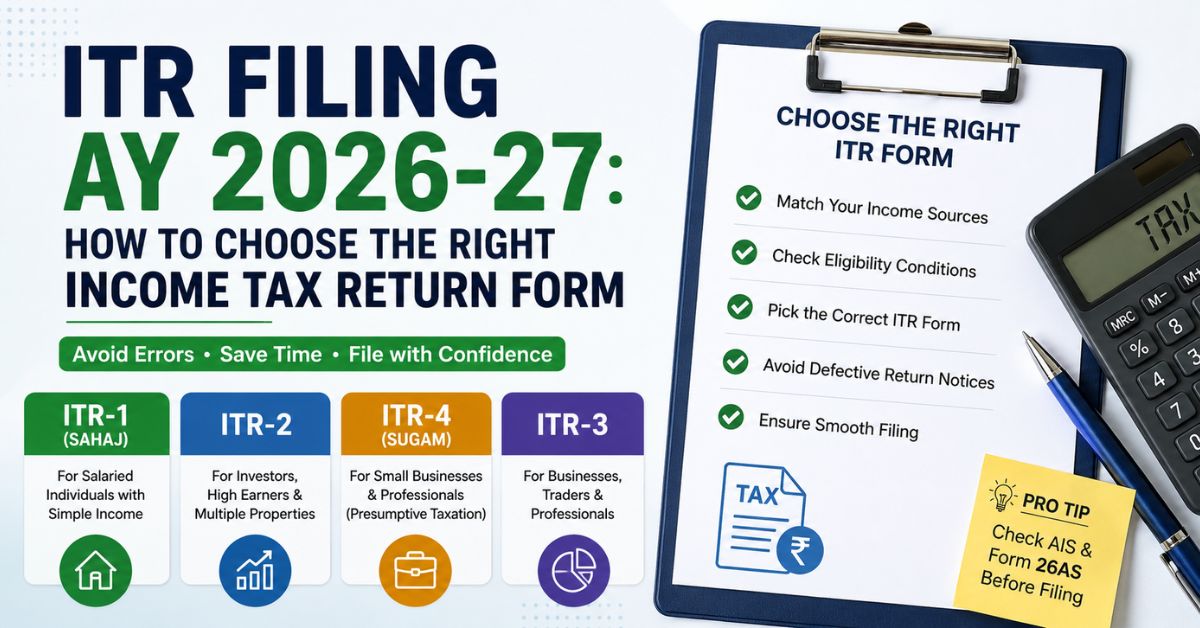
- Choosing the correct ITR form is one of the most important steps while filing Income Tax Returns for AY 2026-27.
- Filing the wrong ITR form may result in the return being treated as defective by the Income Tax Department.
- ITR-1 is generally meant for salaried individuals with simple income sources and income up to ₹50 lakh.
- ITR-2 is commonly used by investors, high-income earners, NRIs, and individuals with capital gains or multiple properties.
- ITR-4 is designed for eligible taxpayers opting for the presumptive taxation scheme.
- ITR-3 is generally used by business owners, professionals maintaining books of accounts, traders, and partners in firms.
- Taxpayers should review AIS and Form 26AS before filing to avoid reporting mismatches.
As taxpayers begin preparing their Income Tax Returns (ITRs) for Assessment Year (AY) 2026-27, one of the most important decisions is selecting the correct ITR form. While filing returns has become easier through pre-filled information and online filing tools, choosing the wrong form can still create problems for taxpayers.
According to Income Tax Department rules, filing an incorrect ITR form may result in the return being treated as defective. In such cases, taxpayers may receive a notice asking them to correct and refile their return within a specified period.
The choice of ITR form depends mainly on the taxpayer’s source of income, total annual income, investment activity, and whether they earn income from business or professional services.
Here is a detailed guide to help taxpayers understand which ITR form may apply to them for AY 2026-27.
Why Choosing the Correct ITR Form Matters
Every ITR form is designed for a specific category of taxpayers. A salaried employee with simple income requirements does not need to provide the same details as a business owner or a stock market trader.
The Income Tax Department uses different forms to collect relevant information from different types of taxpayers. If a taxpayer files using a form that does not match their income profile, the return may be rejected or marked as defective.
Before selecting a form, taxpayers should carefully review all their income sources, including salary, pension, rental income, bank interest, stock market transactions, freelance income, and foreign assets.
The Quick Elimination Test
Before looking at individual forms, taxpayers can use a simple checklist.
If the answer is “Yes” to any of the following questions, they generally cannot use the simpler ITR forms such as ITR-1 and may need to consider ITR-2 or ITR-3 instead.
Check These Conditions
- Is your total annual income above ₹50 lakh?
- Are you a Non-Resident Indian (NRI)?
- Are you a director in a company?
- Do you own unlisted equity shares?
- Have you sold shares, mutual funds, property, gold, or other investments resulting in capital gains?
- Do you own foreign assets or earn foreign income?
- Do you want to carry forward losses from previous years?
If any of these situations apply, taxpayers should carefully review the eligibility rules before selecting their return form.
ITR-1 (Sahaj): For Salaried Individuals With Simple Income
ITR-1, also known as Sahaj, remains one of the most commonly used return forms in India.
It is primarily designed for resident individuals with relatively simple financial situations.
Who Can File ITR-1?
Generally, ITR-1 can be used by resident individuals whose total income does not exceed ₹50 lakh and whose income comes from:
- Salary
- Pension
- One house property
- Savings account interest
- Fixed deposit interest
- Other eligible income from “Other Sources”
This form is often suitable for salaried employees, retired pensioners, and individuals who earn interest income from banks.
Example
A salaried employee earning ₹18 lakh annually, receiving interest from fixed deposits, and owning one self-occupied house would generally fall under ITR-1 eligibility.
However, taxpayers should verify current eligibility conditions before filing, especially if they have investment income or special transactions during the financial year.
ITR-2: For Investors, High-Income Individuals, and Multiple Property Owners
ITR-2 is designed for individuals and Hindu Undivided Families (HUFs) who do not have business or professional income but have more complex financial situations than those covered under ITR-1.
Who Should Consider ITR-2?
Taxpayers may need ITR-2 if they have:
- Income above ₹50 lakh
- Capital gains from shares, mutual funds, property, or other assets
- Income from more than one house property
- Foreign assets
- Foreign income
- NRI status
- Other income that makes them ineligible for ITR-1
Example
Consider a salaried employee earning ₹22 lakh annually who sold mutual funds during the year and earned capital gains.
Even though the person has no business income, the capital gains transaction may require filing ITR-2 instead of ITR-1.
Similarly, an individual earning rental income from multiple properties may also need to file ITR-2.
ITR-4 (Sugam): For Small Businesses and Professionals Using Presumptive Taxation
ITR-4, also known as Sugam, is designed for small businesses and professionals who opt for the presumptive taxation scheme.
The form aims to simplify tax compliance by reducing bookkeeping requirements.
What Is Presumptive Taxation?
Under presumptive taxation, taxpayers declare income as a fixed percentage of their turnover or gross receipts instead of maintaining detailed books of accounts.
Relevant provisions include:
- Section 44AD for eligible businesses
- Section 44ADA for specified professionals
- Section 44AE for certain transport businesses
Who Can Use ITR-4?
ITR-4 is generally available to resident individuals, HUFs, and eligible firms that choose presumptive taxation and satisfy prescribed conditions.
The form is commonly used by:
- Freelancers
- Consultants
- Doctors
- Architects
- Small traders
- Shop owners
Example
A freelance graphic designer earning professional receipts and opting for presumptive taxation under Section 44ADA may be eligible to file ITR-4, provided all eligibility conditions are met.
The form also accommodates certain additional income sources such as salary income, interest income, and income from a house property, subject to prescribed limits and conditions.
ITR-3: For Businesses, Professionals, Traders, and Partners
ITR-3 is considered one of the more comprehensive return forms available to individuals and HUFs.
It is intended for taxpayers earning income from business or profession who either do not qualify for ITR-4 or choose not to use the presumptive taxation scheme.
Who Should File ITR-3?
ITR-3 is commonly used by:
- Proprietary business owners
- Professionals maintaining books of accounts
- Stock market traders
- Futures and Options (F&O) traders
- Intraday traders
- Cryptocurrency traders
- Partners in partnership firms
Why Is ITR-3 More Detailed?
Unlike simplified forms, ITR-3 often requires detailed financial information, including:
- Profit and Loss statements
- Balance Sheet details
- Business expenses
- Asset and liability disclosures
This allows taxpayers to report complex business activities accurately.
Example
A trader actively dealing in Futures and Options transactions throughout the year would generally need to file ITR-3 because such trading income is treated differently from regular investment income.
Similarly, a consultant maintaining detailed accounting records rather than using presumptive taxation may also file ITR-3.
Common Mistakes Taxpayers Should Avoid
Tax experts often observe that taxpayers make mistakes while selecting forms because they focus only on their primary source of income.
However, even a single transaction can affect eligibility.
Some common errors include:
- Filing ITR-1 despite having capital gains
- Ignoring foreign asset disclosures
- Not reporting income from multiple house properties
- Using ITR-4 without satisfying presumptive taxation conditions
- Reporting trading income in the wrong form
Reviewing all income sources before filing can help avoid such mistakes.
Check AIS and Form 26AS Before Filing
Experts also recommend reviewing the Annual Information Statement (AIS) and Form 26AS before starting the return filing process.
These documents contain information already available with the Income Tax Department, including:
- Interest income
- Tax deducted at source (TDS)
- Securities transactions
- Dividend income
- Property transactions
- Other reported financial activities
Comparing personal records with AIS and Form 26AS can help taxpayers identify mismatches before filing.
Doing so may reduce the chances of receiving tax notices later.
A Simple Rule for Most Taxpayers
For most individuals, selecting the correct form can be simplified through a basic approach.
| If your situation is… | Likely ITR Form |
|---|---|
| Salaried employee with income below ₹50 lakh and straightforward finances | ITR-1 |
| Salaried person with capital gains, foreign assets, multiple properties, or higher income | ITR-2 |
| Freelancer or small business owner opting for presumptive taxation | ITR-4 |
| Business owners, active traders, and professionals maintaining detailed books of accounts | ITR-3 |
Also Read
AY 2026-27 ITR Due Dates: Key Income Tax Return Filing Deadlines Taxpayers Must Know
Filing your Income Tax Return on time is just as important as choosing the correct ITR form. Check the complete AY 2026-27 ITR due dates, important deadlines, and key filing timelines to avoid penalties and compliance issues.
Bottom Line
The correct ITR form for AY 2026-27 depends on more than just how much a taxpayer earns. The nature of income, investment activity, business involvement, and ownership of assets all play a role in determining eligibility.
While ITR-1 remains suitable for many salaried individuals, taxpayers with capital gains, business income, trading activity, foreign assets, or multiple properties may need to choose a different form.
Before filing, taxpayers should review their complete income profile, verify information available in AIS and Form 26AS, and ensure that the selected ITR form matches their financial situation. Taking a few extra minutes to choose the correct form can help avoid defective return notices and make the filing process much smoother.