


Article Summary
- The rivalry between Iran, Israel, and the United States evolved over two decades through covert operations, intelligence activity, and proxy conflicts across the Middle East.
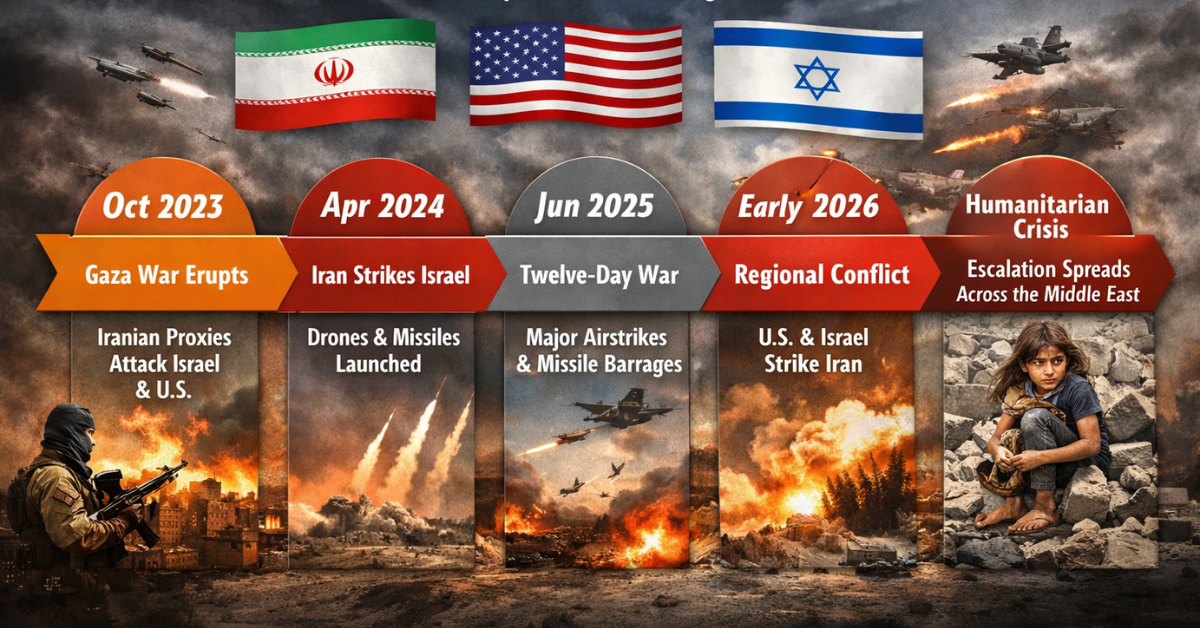
- Tensions intensified after the October 2023 Gaza war as Iranian-aligned groups increased attacks on Israeli positions and United States military bases.
- In April 2024, Iran launched its first direct military strike on Israeli territory using drones and ballistic missiles, marking a historic escalation.
- In June 2025, a twelve-day war began after Israeli strikes on Iranian military and nuclear-linked facilities, followed by large missile attacks from Iran.
- By early 2026, coordinated strikes involving Israel and the United States against Iranian strategic sites expanded the confrontation into a broader regional conflict.
- The crisis has begun affecting global oil markets, international air travel, and regional stability while diplomatic efforts attempt to prevent a wider war.
For decades, tension between Iran, Israel, and the United States shaped the security landscape of the Middle East. What began as covert operations, intelligence battles, and proxy conflicts gradually developed into direct confrontation. The following timeline traces the key events that escalated the rivalry into open warfare and regional instability.
Background: The Shadow Conflict (2000s–2022)
For many years, Iran and Israel avoided direct war but engaged in covert confrontation.
Israel repeatedly warned that Iran’s nuclear program posed an existential threat. Iranian officials maintained that the program was intended for civilian energy production. At the same time, Iran expanded its regional alliances with armed groups across the Middle East.
These groups included Hezbollah in Lebanon, militias in Iraq and Syria, and later the Houthi movement in Yemen. Israel and the United States accused Iran of supplying these organizations with weapons and training.
During this period, several developments shaped the rivalry.
Israel conducted cyber operations and sabotage against Iranian nuclear facilities. Iranian nuclear scientists were assassinated in operations widely attributed to Israeli intelligence. Iran responded by strengthening its network of regional allies and increasing missile production.
Despite frequent confrontation, the conflict remained indirect.
2023: Regional Crisis After the Gaza War
October 7, 2023
Militants from Hamas launched a large attack on Israel from the Gaza Strip. Israel responded with a large-scale military campaign in Gaza.
The war quickly expanded into a broader regional crisis.
Armed groups aligned with Iran increased attacks against Israeli positions. Rocket fire intensified along the Israel-Lebanon border. Iranian-aligned militias in Iraq and Syria began targeting American military bases. Shipping routes in the Red Sea also came under attack.
The United States deployed additional naval forces to the eastern Mediterranean and Persian Gulf to deter wider escalation.
Although Iran denied direct involvement in the Hamas attack, tensions between Tehran and Washington rose sharply.
2024: First Direct Iran–Israel Military Exchange
February 2024
A major Iranian gas pipeline was damaged in an operation widely attributed to Israeli sabotage. Iranian officials condemned the attack and accused Israel of expanding covert operations inside Iranian territory.
April 1, 2024
An airstrike destroyed the Iranian consular compound in Damascus, Syria. The attack killed several senior members of Iran’s Islamic Revolutionary Guard Corps.
Iran blamed Israel and promised retaliation.
April 13–14, 2024
Iran launched a large aerial assault against Israel using drones and ballistic missiles. Hundreds of projectiles were fired toward Israeli territory.
Israel, supported by the United States and several regional partners, intercepted most of the incoming weapons.
The attack marked a historic moment. For the first time, Iran launched a direct strike on Israeli territory from its own soil.
Late 2024: Increasing Military Pressure
Throughout the remainder of 2024, both sides expanded military operations.
Israel continued airstrikes against Iranian positions and weapons transfers in Syria and Lebanon. Iranian-aligned militias increased attacks on Israeli forces along the northern border.
American forces in Iraq and Syria were also targeted by rockets and drones launched by militia groups aligned with Iran.
Diplomatic efforts attempted to contain the crisis, but tensions continued to rise.
June 2025: The Twelve-Day War
June 13, 2025
Israel launched a large air campaign against Iranian military infrastructure and nuclear-related facilities. Israeli officials stated that the operation aimed to prevent Iran from advancing toward nuclear weapons capability.
Key sites connected to Iran’s nuclear program and missile development were targeted.
June 14–19, 2025
Iran responded with waves of ballistic missile attacks aimed at Israeli military facilities and major cities. Missile sirens sounded across Israel as air defense systems attempted to intercept incoming weapons.
Expansion of the Conflict
During the fighting, Iranian-aligned militias in Iraq and Syria launched attacks against United States bases. Hezbollah also increased military pressure along Israel’s northern border.
The United States supported Israel with missile defense operations and logistical assistance.
Late June 2025
After nearly two weeks of fighting, the conflict subsided under international diplomatic pressure.
The war caused significant casualties and infrastructure damage but ended without a decisive resolution. Regional tensions remained high.
Late 2025: A Fragile Standoff
Following the brief war, both sides increased military preparedness.
Iran expanded missile production and reinforced strategic facilities. Israel continued targeting Iranian supply routes in Syria and Lebanon. American forces maintained a strong military presence across the Persian Gulf.
Analysts increasingly warned that another confrontation could occur if diplomatic efforts failed.
Early 2026: Escalation Into a Regional War
February 2026
A coordinated military offensive involving Israel and the United States targeted multiple Iranian military and strategic facilities.
Airstrikes were reported across several Iranian cities, including areas around Tehran. Iranian officials described the attacks as an act of war.
The strikes marked one of the most serious escalations in the history of the conflict.
Iranian Retaliation
Iran responded with missile and drone attacks aimed at Israeli territory and United States military bases in the region.
Explosions were reported near American facilities in several Middle Eastern countries hosting U.S. forces. At the same time, Iranian-aligned armed groups expanded attacks on Israeli and American targets.
Israeli forces also launched strikes against Hezbollah positions in Lebanon as the northern front intensified.
The conflict rapidly spread across multiple countries.
Regional and Global Impact
The war quickly affected global markets and transportation.
Airspace across parts of the Persian Gulf was temporarily closed as missile activity increased. International airlines diverted or cancelled flights through the region.
Oil markets reacted sharply due to fears that the conflict could disrupt shipping through the Strait of Hormuz, one of the world’s most important energy routes.
Governments across Europe, Asia, and the Middle East called for restraint and urgent diplomatic negotiations.
Humanitarian Concerns
As the fighting expanded, civilian casualties increased.
Reports emerged of damage to residential areas and public buildings in several locations. Human rights organizations warned that prolonged conflict could produce a major humanitarian crisis across the region.
The United Nations convened emergency sessions to discuss ceasefire proposals and conflict mediation.
The Situation Now
The confrontation between Iran, Israel, and the United States remains one of the most dangerous geopolitical crises in the Middle East.
Military operations and retaliatory strikes continue while diplomatic efforts attempt to prevent the conflict from expanding further.
Whether the situation evolves toward wider regional war or eventual negotiations remains uncertain.