


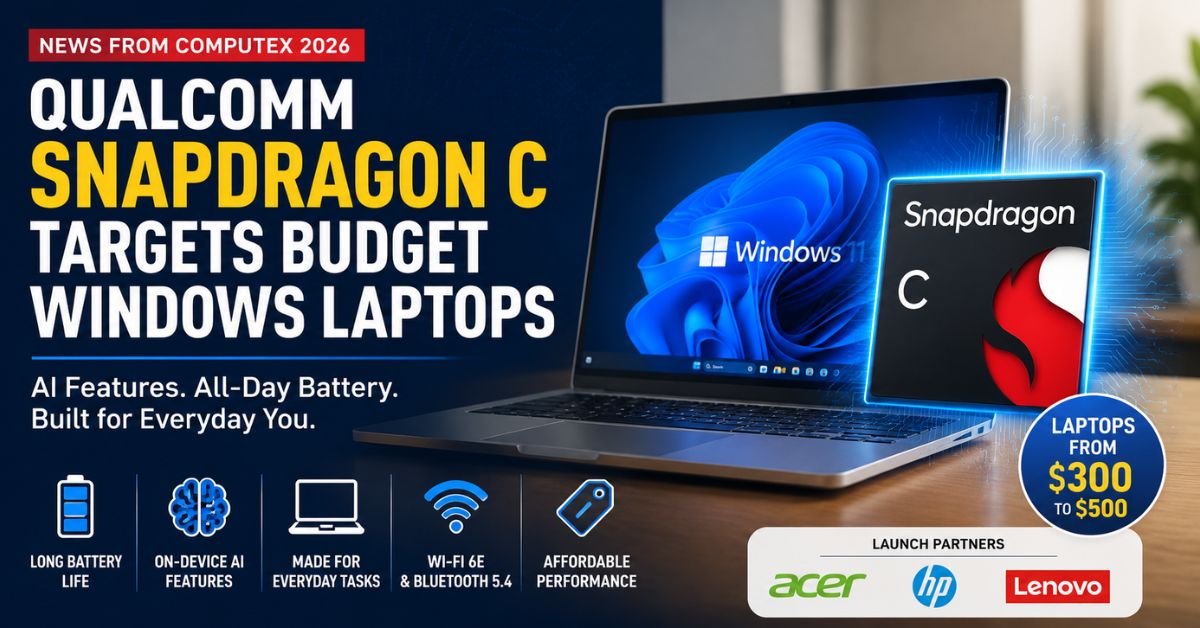
Snapdragon C Platform: Key Takeaways
- Qualcomm has introduced the Snapdragon C Platform for affordable Windows laptops expected to be priced between $300 and $500.
- The new platform targets students, families, frontline workers, and small businesses that need dependable everyday computing.
- Snapdragon C uses Kryo CPU technology instead of Qualcomm’s premium Oryon architecture found in Snapdragon X processors.
- The platform includes AI capabilities for everyday tasks but does not qualify for Microsoft’s Copilot+ PC requirements.
- Acer, HP, and Lenovo are among the first manufacturers expected to launch Snapdragon C-powered devices.
Qualcomm has announced the Snapdragon C Platform, a new processor designed to power affordable Windows laptops. Revealed ahead of Computex 2026, the platform marks the company’s latest effort to bring Arm-based computing to a wider audience by targeting entry-level devices expected to sell in the $300 to $500 price range.
The announcement represents a significant expansion of Qualcomm’s PC strategy. While the company has recently focused on premium Snapdragon X-powered laptops with advanced AI features, Snapdragon C is aimed at a much broader segment of the market where affordability, battery life, and everyday usability are often more important than high-end performance.
Qualcomm Expands Its Windows PC Ambitions
Over the past two years, Qualcomm has invested heavily in premium Windows-on-Arm laptops powered by its Snapdragon X series processors. Those devices were designed to compete with Intel and AMD-powered notebooks while offering improved battery life and AI capabilities.
With Snapdragon C, Qualcomm is taking a different approach. Rather than targeting professionals and power users, the company is focusing on mainstream consumers who use laptops for common daily activities such as web browsing, email, online learning, office work, video calls, and streaming.
Qualcomm has confirmed that the letter “C” stands for “Compute,” reflecting the company’s goal of delivering responsive computing experiences at a more accessible price point.
Built for Everyday Productivity
The Snapdragon C Platform is designed to handle the tasks that most users perform every day. Students attending online classes, families sharing a home computer, and small businesses running productivity applications are the primary audience for these devices.
Unlike premium laptops that focus on demanding workloads such as video editing or advanced gaming, Snapdragon C devices are expected to prioritize efficiency, responsiveness, and battery life.
This strategy allows laptop manufacturers to build affordable systems without sacrificing the modern Windows experience that users expect.
How Snapdragon C Differs from Snapdragon X
One of the biggest differences between Snapdragon C and Qualcomm’s premium Snapdragon X lineup is the processor architecture.
Snapdragon X processors use Qualcomm’s custom Oryon CPU cores, which were developed specifically for high-performance computing. Snapdragon C instead relies on Kryo CPU technology, which enables Qualcomm to reduce costs while maintaining the efficiency advantages associated with Arm-based processors.
This distinction is important because Snapdragon C is not intended to compete directly with premium laptops. Instead, it is positioned as an affordable alternative for users who need reliable performance for everyday tasks.
The focus is less on benchmark results and more on delivering a smooth user experience throughout the day.
Battery Life and Efficiency Remain Key Priorities
One of the main advantages of Arm-based processors is their ability to deliver strong battery life while consuming less power.
Qualcomm expects Snapdragon C laptops to benefit from this efficiency-focused design. Lower power consumption can help laptops remain operational for longer periods between charges while also producing less heat.
For consumers, this could result in devices that run cooler, stay quieter, and require less aggressive cooling systems than traditional budget laptops.
Although real-world battery performance will vary depending on device design and usage patterns, efficiency remains one of the platform’s primary selling points.
AI Features Included for Everyday Tasks
Artificial intelligence continues to play an important role across Qualcomm’s product lineup, including the new Snapdragon C Platform.
The processor includes a dedicated Neural Processing Unit (NPU), which is designed to handle AI-related workloads more efficiently than a standard CPU.
These AI capabilities can support features such as:
- Background noise suppression during video calls
- Automatic webcam framing and image enhancements
- Voice recognition functions
- AI-assisted productivity tools
- Selected Windows 11 AI experiences
However, Qualcomm has positioned Snapdragon C below Microsoft’s Copilot+ PC category. As a result, buyers should not expect access to every advanced AI feature available on premium Windows AI PCs.
Instead, the focus appears to be on practical AI functions that improve everyday computing without increasing device costs.
Several Technical Specifications Remain Undisclosed
While Qualcomm has introduced the platform and outlined its intended purpose, the company has not released a complete technical specification sheet.
Reports from industry analysts have suggested possible connections to existing Qualcomm mobile architectures, but Qualcomm has not officially confirmed details regarding the exact CPU configuration, graphics architecture, clock speeds, or full AI performance capabilities.
Because of this, many hardware specifications currently circulating online should be viewed as industry analysis rather than confirmed information.
More details are expected to emerge as additional devices become available and independent reviewers conduct performance testing.
What We Know About Snapdragon C Hardware
| Category | Current Status |
|---|---|
| Processor Family | Officially confirmed as Snapdragon C Platform |
| CPU Architecture | Kryo CPU technology confirmed |
| AI Processing | Dedicated NPU confirmed |
| Copilot+ PC Support | Does not qualify |
| Target Pricing | Approximately $300 to $500 devices |
| Launch Partners | Acer, HP, and Lenovo confirmed |
Acer Launches the First Snapdragon C Laptop
Acer is among the first manufacturers to adopt Qualcomm’s new platform.
The company has introduced the Acer Aspire Go 15, which is expected to become one of the first commercially available laptops powered by Snapdragon C.
The Aspire Go 15 is positioned as an affordable notebook designed for general-purpose computing and includes several features commonly found in mainstream laptops.
| Feature | Acer Aspire Go 15 |
|---|---|
| Display | 15.6-inch Full HD |
| Memory | Up to 8GB RAM |
| Storage | Up to 512GB SSD |
| Webcam | 1080p Camera |
| Wireless Connectivity | Wi-Fi 6E |
| Operating System | Windows 11 |
The specifications indicate that Acer is targeting students, remote workers, and families looking for a practical laptop without the premium price associated with higher-end devices.
HP and Lenovo Prepare Their Own Devices
Qualcomm’s plans extend beyond Acer. Both HP and Lenovo are expected to introduce Snapdragon C-powered laptops as part of the platform’s initial rollout.
The participation of multiple global PC manufacturers is important because it gives consumers more choices while helping expand the Windows-on-Arm ecosystem.
A broader range of devices could also encourage software developers to continue optimizing applications for Arm processors, improving compatibility and performance across the platform.
Competing Against Intel, AMD, and Chromebooks
The budget laptop market remains one of the most competitive segments in the PC industry.
Intel’s low-power Core processors and AMD’s Ryzen U-series chips currently power a large number of affordable Windows laptops. At the same time, Chromebooks continue to be popular among schools and educational institutions due to their low cost and simplicity.
Qualcomm hopes Snapdragon C can stand out by offering a combination of battery efficiency, modern AI capabilities, and the full Windows operating system.
For many consumers, especially students and remote workers, battery life and portability can be just as important as processing power.
Why the Snapdragon C Launch Matters
The introduction of Snapdragon C is significant because it extends Qualcomm’s reach beyond premium AI laptops and into a much larger portion of the PC market.
Affordable laptops account for a substantial share of global PC sales. By targeting this segment, Qualcomm has an opportunity to increase adoption of Arm-based Windows devices among mainstream consumers.
The move also reflects broader trends across the technology industry. As battery efficiency and AI features become increasingly important, chipmakers are looking for ways to deliver modern computing experiences without significantly increasing hardware costs.
For Microsoft, the arrival of more affordable Windows-on-Arm devices could help strengthen the platform’s ecosystem and attract additional software support.
What Buyers Can Expect
Consumers considering a Snapdragon C laptop should view it as a device built primarily for everyday computing rather than intensive professional workloads.
The platform is expected to perform well for web browsing, email, Microsoft Office applications, online learning, video conferencing, streaming services, and cloud-based productivity tools.
Users who require advanced gaming performance, large-scale content creation capabilities, or demanding workstation applications will likely be better served by higher-end processors.
For everyone else, Snapdragon C could offer an attractive balance of affordability, battery life, and modern Windows functionality.
The Next Phase of Qualcomm’s PC Strategy
Qualcomm’s Snapdragon C Platform represents a new phase in the company’s effort to establish a larger presence in the Windows PC market. Rather than focusing exclusively on premium AI laptops, the company is now targeting consumers who prioritize value and practicality.
Many questions about the platform’s technical capabilities remain unanswered, and independent reviews will ultimately determine how well Snapdragon C performs in real-world conditions. Nevertheless, the direction of Qualcomm’s strategy is clear.
By bringing Arm-based computing to lower-priced Windows laptops, Qualcomm is aiming to make efficient, connected, and AI-capable PCs accessible to a much wider audience. As devices from Acer, HP, and Lenovo begin reaching consumers, the success of Snapdragon C will provide an important test of whether Windows-on-Arm can gain momentum in the mainstream laptop market.
Also Read
-
Qualcomm Snapdragon vs Intel Core i7: Which Processor Is Better for Your Laptop? -
Snapdragon vs Intel Core i5: Which Processor Is Better for Your Next Laptop in 2026?