


Key Takeaways
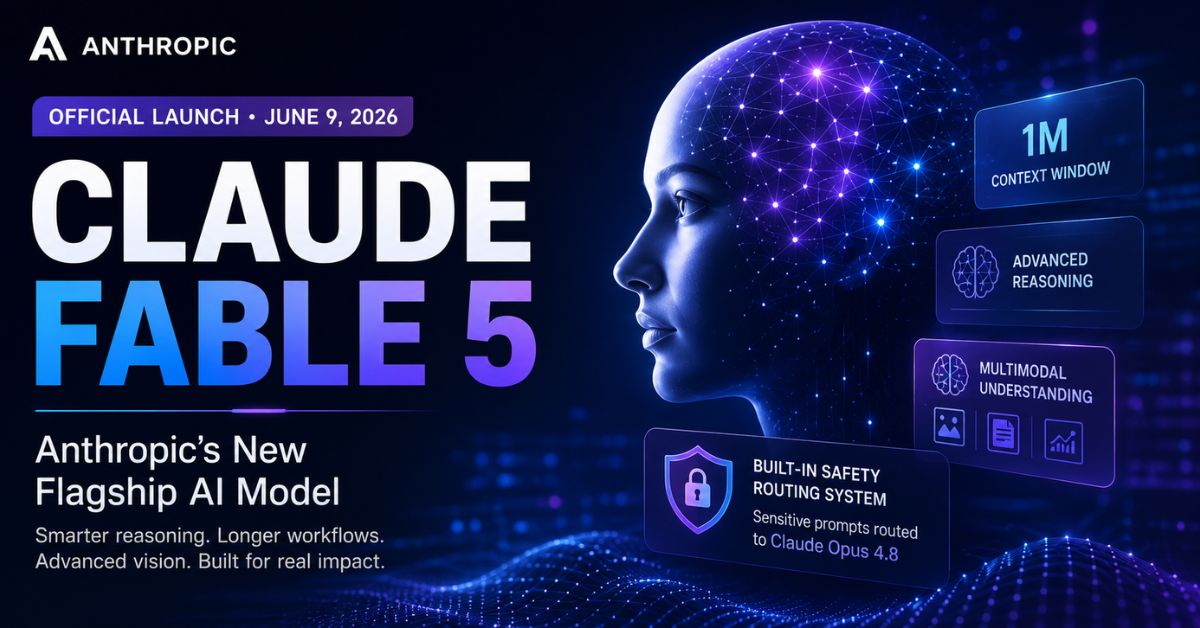
- Anthropic has launched Claude Fable 5, its most powerful publicly available AI model to date.
- The model is based on the same Mythos-class architecture that powers the restricted Claude Mythos 5.
- Claude Fable 5 focuses on long-running workflows, advanced reasoning, coding, and multimodal capabilities.
- A unique safety routing system redirects sensitive cybersecurity and biology-related prompts to Claude Opus 4.8.
- Fable 5 is available through Claude subscriptions, the Claude API, and major enterprise AI platforms.
Anthropic has officially launched Claude Fable 5, its newest flagship artificial intelligence model, marking one of the biggest AI releases of 2026. Unveiled on June 9, the model introduces Anthropic’s fifth-generation Mythos-class architecture to public and enterprise users for the first time.
The launch is significant because Fable 5 is built on the same foundation as Claude Mythos 5, a highly restricted research model that has largely remained out of reach for the public. Anthropic says Fable 5 delivers similar capabilities while incorporating additional safety systems designed to make the technology suitable for broader use.
The announcement arrives amid growing competition among AI companies, with Anthropic, OpenAI, Google, and other major players racing to develop more capable models that can handle increasingly complex tasks.
For developers, businesses, researchers, and everyday users, Claude Fable 5 could represent one of the most important AI upgrades released this year.
What Is Claude Fable 5?
Claude Fable 5 is Anthropic’s newest large language model designed to handle advanced reasoning, coding, research, document analysis, and autonomous workflows.
Unlike traditional AI chatbots that respond to one prompt at a time, Fable 5 is built to work on longer and more complex projects. Anthropic describes the model as being capable of planning tasks across multiple stages, checking its own work, and maintaining focus on large projects for extended periods.
The company positions Fable 5 as its most capable publicly available model to date.
While Claude Mythos 5 remains restricted to select organizations and research environments, Fable 5 brings much of that technology to commercial and public users through Anthropic’s platform and API services.
The result is a model aimed at people who need more than simple question-and-answer interactions.
Why the Launch Is Getting Attention
Every major AI company is currently trying to solve a similar challenge: creating models that can reliably complete difficult tasks without constant human supervision.
Most current AI systems still require users to repeatedly guide them through complicated projects. Anthropic believes Fable 5 moves closer to solving that problem.
The company says the model is specifically designed for what it calls “long-horizon autonomy.” In simple terms, that means the AI can work through larger assignments that may involve multiple steps, decisions, and revisions.
Instead of stopping after every instruction, the model can continue working toward a larger goal while maintaining context.
This capability is one reason many AI experts are paying close attention to the release.
Long-Running AI Workflows Are a Major Focus
One of the headline features of Claude Fable 5 is its ability to manage extended workflows.
According to Anthropic and early testing reports, the model performs particularly well when handling software development projects, research assignments, and tasks that involve multiple stages of planning.
For example, rather than simply generating code snippets, Fable 5 may be able to design a broader software solution, write supporting components, test functionality, identify mistakes, and revise its output.
This type of workflow is becoming increasingly important as businesses explore AI-powered automation.
The model has also been optimized for environments such as Claude Code, where AI systems can interact with development tools and work through larger engineering projects.
While some of the more ambitious claims are still being evaluated by developers, early reactions suggest that Fable 5 performs noticeably better on lengthy tasks than previous Claude models.
Anthropic Claims Better “First-Shot” Results
Another area generating discussion is what Anthropic calls improved first-pass performance.
Many AI users are familiar with a common challenge: receiving an answer from a model, discovering mistakes, and then spending multiple prompts correcting those errors.
According to early reports from testers, Claude Fable 5 often requires fewer revisions before reaching a usable solution.
This does not mean the model is always correct. However, testers have reported that it frequently produces stronger initial results than previous systems.
For businesses and developers, reducing the number of correction cycles can save considerable time and effort.
As organizations increasingly rely on AI tools for productivity, improvements in accuracy may become just as important as raw intelligence.
Advanced Vision Capabilities Expand Beyond Text
Like many leading AI models released over the past two years, Claude Fable 5 is not limited to text alone.
The model includes advanced multimodal capabilities that allow it to analyze and understand visual information.
Anthropic says Fable 5 can work with complex images, technical diagrams, user interface designs, charts, and document layouts.
This means users can upload visual materials and ask the model to explain, summarize, or analyze them.
For example, businesses could use the system to review reports, examine presentations, or understand complicated technical documents.
Developers may also use visual understanding capabilities when reviewing application designs or identifying inconsistencies in user interfaces.
The addition of stronger vision capabilities reflects a broader trend across the AI industry, where models are increasingly expected to process text, images, and other forms of information within the same conversation.
A Massive Context Window Could Change How People Use AI
One of the most widely discussed specifications associated with Claude Fable 5 is its reported context window.
A context window refers to the amount of information an AI model can remember and process during a conversation.
Reports surrounding the launch suggest Fable 5 supports a context window of up to one million tokens, allowing users to work with extremely large amounts of information in a single session.
If fully available, this would allow organizations to upload large codebases, extensive legal documents, lengthy financial reports, or collections of research material without constantly splitting files into smaller sections.
For users working with large projects, context size often determines whether an AI system remains useful throughout an entire workflow.
Although developers are awaiting additional documentation regarding the exact implementation, the reported context capacity has attracted significant attention.
Anthropic Introduces a Unique Safety System
Perhaps the most distinctive aspect of Claude Fable 5 is its safety architecture.
As AI models become more capable, concerns about misuse have also increased.
To address those concerns, Anthropic has implemented a system that continuously monitors requests for certain categories of sensitive content.
When the model detects prompts involving areas such as offensive cybersecurity activities or advanced biological topics, the request may be automatically redirected.
Instead of allowing Fable 5 to answer directly, the system routes the request to Claude Opus 4.8.
Anthropic says this approach helps balance capability and safety while allowing the company to release more advanced models to a wider audience.
The company has indicated that fallback routing affects only a small percentage of requests.
This safety mechanism represents one of the most unusual design choices among major AI model providers today.
Claude Fable 5 Pricing Explained
| Feature | Specification |
|---|---|
| Input Token Price | $10 per million tokens |
| Output Token Price | $50 per million tokens |
| Reported Context Window | Up to 1 million tokens |
| Maximum Output | 128,000 tokens |
While these rates place Fable 5 among the more expensive AI models on the market, the company argues that the model’s capabilities justify the higher cost.
Organizations using Fable 5 for advanced coding, research, and automation tasks may view the increased performance as worth the premium pricing.
For everyday users, access is currently available through supported Claude subscription plans.
Where Is Claude Fable 5 Available?
Anthropic is making Fable 5 available across multiple platforms.
- Claude API
- Claude Pro
- Claude Max
- Claude Team
- Enterprise plans
- Amazon Bedrock
- Google Vertex AI
- Microsoft Foundry
The company is also expanding availability through major cloud providers and enterprise AI platforms.
This broad rollout strategy is intended to make adoption easier for businesses already operating within existing cloud environments.
Temporary Rollout Plan for June 2026
To manage demand, Anthropic has introduced a phased rollout strategy.
From June 9 through June 22, Claude Fable 5 is included with supported Claude subscription plans at no additional charge. This allows users to experiment with the model during the initial launch period.
Beginning June 23, Anthropic plans to temporarily move standalone access to a usage-credit system while expanding infrastructure capacity.
The company says the goal is to eventually return the model to a more traditional subscription-based structure once scaling requirements are addressed.
The approach reflects the enormous computing resources required to operate next-generation AI systems.
What Claude Fable 5 Means for the Future of AI
The launch of Claude Fable 5 highlights how quickly artificial intelligence technology continues to evolve.
Just a few years ago, AI systems were primarily used for answering questions and generating text. Today, companies are building models capable of analyzing large datasets, assisting with software development, reviewing complex documents, and carrying out multi-stage workflows.
Anthropic’s latest release pushes further in that direction.
By combining advanced reasoning, stronger visual understanding, long-context processing, and a unique safety framework, Claude Fable 5 is designed to tackle tasks that would have previously required significant human effort.
The coming months will determine whether the model lives up to the expectations created by its launch. Developers, businesses, and AI researchers will be watching closely to see how it performs in real-world environments.
For now, one thing is clear: Claude Fable 5 is not just another model update. It represents Anthropic’s most ambitious public AI release yet and could play a major role in shaping the next stage of the AI industry.