


Key Takeaways
- Apple has unveiled iOS 27 with a major overhaul of Siri, now branded as Siri AI.
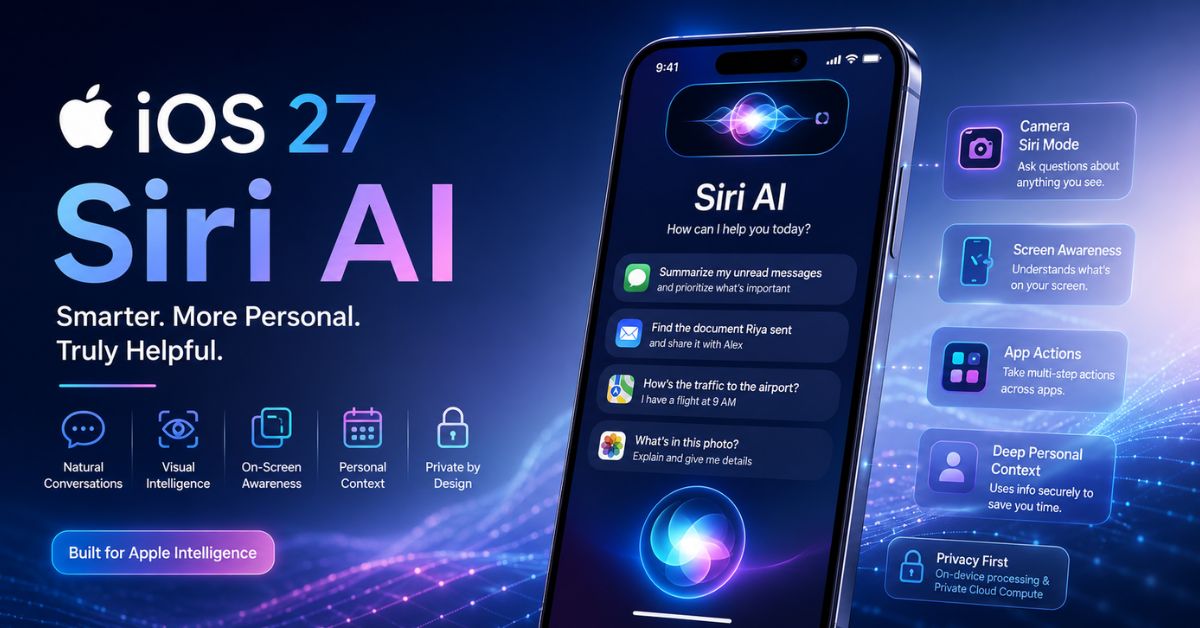
- The new assistant offers conversational AI, screen awareness, visual intelligence, and deeper app integration.
- A dedicated Siri app brings chat-based interactions, file uploads, and conversation history across devices.
- Apple says Siri AI prioritizes privacy through on-device processing and Private Cloud Compute.
- While iOS 27 supports iPhone 11 and newer models, Siri AI features are limited to select newer devices.
Apple has officially introduced iOS 27 at its Worldwide Developers Conference (WWDC) 2026, and the biggest announcement is the complete transformation of Siri. The company has rebuilt its digital assistant around artificial intelligence, introducing what it now calls Siri AI.
The new assistant is designed to be more conversational, more aware of personal context, and far more capable than previous versions of Siri. Apple says Siri AI can understand what is happening on a user’s screen, perform actions across apps, analyze images through the camera, and respond using information from messages, calendars, emails, and photos.
The launch marks one of Apple’s most significant software changes in years as the company expands its Apple Intelligence platform across the iPhone ecosystem.
Siri AI Replaces the Traditional Siri Experience
For years, Siri has faced criticism for lagging behind newer AI assistants. With iOS 27, Apple appears to be addressing those concerns by rebuilding the assistant from the ground up.
The familiar Siri experience is being replaced by a more advanced AI-powered system capable of holding natural conversations and handling more complex requests. Instead of responding to a single command at a time, Siri AI is designed to understand context and complete tasks that involve multiple steps.
Apple says the assistant can remember details from an ongoing conversation, making interactions feel more natural and less repetitive. Users will not need to restate information every time they ask a follow-up question.
The goal is to make Siri function less like a traditional voice assistant and more like a digital companion that understands what users are trying to accomplish.
New Interface Brings Siri Closer to Daily Use
One of the most visible changes in iOS 27 is Siri’s redesigned interface.
Reports following WWDC indicate that the classic glowing Siri orb has been removed in favor of a new experience integrated into the Dynamic Island. When activated, Siri AI expands with new animations and controls, allowing users to interact without taking over the entire display.
Apple is also introducing a new “Search or Ask” experience that combines device search and AI assistance in a single interface. This is intended to make information easier to find while giving users quick access to Siri AI whenever needed.
The redesign reflects Apple’s effort to make AI a more natural part of everyday smartphone use rather than a separate tool that users occasionally activate.
Dedicated Siri App Adds Chat Features
Another major addition is a standalone Siri application.
The app gives Siri AI a dedicated space where users can interact through both voice and text. Similar to modern AI chatbots, conversations can continue across multiple exchanges, allowing users to ask follow-up questions without starting over.
The dedicated app also reportedly supports file uploads, photo analysis, and conversation history synced through iCloud. This means users can continue a discussion on different Apple devices while maintaining context.
The move brings Siri closer to the experience offered by leading AI assistants while keeping it deeply integrated into Apple’s ecosystem.
Visual Intelligence Expands Through the Camera
Apple is also expanding Siri’s visual intelligence capabilities.
With the new camera-based Siri experience, users can point their iPhone camera at objects, locations, documents, or products and ask questions about what they see.
For example, Siri AI may be able to identify landmarks, explain information shown on signs, provide details about products, analyze receipts, or offer nutritional information about food.
This feature builds upon Apple’s broader push into multimodal AI, where the assistant can understand text, images, voice, and contextual information at the same time.
By combining camera input with AI reasoning, Apple is aiming to make the iPhone more useful in real-world situations.
Siri Can Understand What’s on Your Screen
One of the most anticipated features is screen awareness.
Apple says Siri AI can understand what users are currently viewing and use that information to complete tasks.
For example, if someone receives a document through email, Siri may be able to locate it and send it to another person through Messages without requiring the user to manually switch between apps.
This deeper understanding of on-screen content could significantly reduce the number of steps required to complete everyday tasks.
Developers will also have opportunities to integrate their applications with Siri AI, allowing the assistant to work across a wider range of services and workflows.
Personal Context Becomes a Core Feature
Another major focus of Siri AI is personal context.
Apple says the assistant can securely access information from messages, photos, calendars, reminders, and other personal data sources to provide more relevant assistance.
For example, Siri could recognize that a user has an upcoming flight, check traffic conditions, and suggest leaving earlier than planned. It could also help locate information mentioned in past conversations or identify details stored in photos and documents.
This level of awareness is intended to make Siri more proactive and useful throughout the day.
At the same time, Apple says privacy protections remain central to how this information is processed.
Apple Continues to Emphasize Privacy
Privacy has become one of Apple’s main selling points in the AI era.
According to the company, Siri AI performs as much processing as possible directly on the device. This approach reduces the need to send personal information to external servers and allows requests to be handled more quickly.
For tasks that require additional computing power, Apple uses its Private Cloud Compute system. The company says this infrastructure is designed so that user data is not stored or made accessible to Apple.
Apple has repeatedly highlighted Private Cloud Compute as a key difference between its AI strategy and many competing services.
Whether these privacy measures will become a major advantage remains to be seen, but Apple is clearly positioning security and user control as central parts of the Siri AI experience.
Voice Improvements and Better Dictation
Siri AI also introduces improvements to voice interactions.
Users will reportedly have greater control over how Siri sounds, including adjustments to speaking style and expressiveness.
At the same time, Apple has upgraded system-wide dictation. The company says dictation can now better understand punctuation, capitalization, formatting, and natural speech patterns.
For users who frequently dictate messages, emails, notes, or documents, these improvements could significantly reduce the need for manual editing.
The enhancements are part of Apple’s broader effort to make voice interaction a more practical way to use the iPhone.
iOS 27 Availability and Release Timeline
Apple has already released the developer beta version of iOS 27.
However, access to Siri AI is currently more limited. Developers interested in testing the new assistant must join Apple’s Apple Intelligence waitlist through the Settings application.
Based on Apple’s typical software release schedule, a public beta is expected during July 2026. The final version of iOS 27 is expected to roll out to all eligible users in September 2026.
As with previous iOS releases, Apple is likely to continue refining Siri AI throughout the beta testing period before the official launch.
Which iPhones Support Siri AI?
Apple’s device compatibility structure appears to separate standard iOS 27 support from Siri AI support.
The operating system itself is expected to run on iPhone 11 models and newer devices. However, access to Siri AI and Apple Intelligence features requires newer hardware with greater memory and processing capabilities.
| Tier | Supported Devices | AI Capability |
|---|---|---|
| Elite On-Device AI | iPhone 17 Pro, iPhone 17 Pro Max, iPhone Air | Most advanced local AI processing and premium Siri AI features |
| Standard Siri AI | iPhone 17, 17e, 16 series, 16e, 15 Pro, 15 Pro Max | Full Siri AI support with greater reliance on Private Cloud Compute |
| iOS 27 Only | iPhone 15, 14 series, 13 series, 12 series, 11 series, supported iPhone SE models | No Siri AI or Apple Intelligence features |
It is important to note that Apple has not publicly published a detailed hardware-tier chart covering every AI capability. Some compatibility information currently comes from reports and early developer findings.
Regional Restrictions Could Limit Availability
Not every user will receive Siri AI immediately.
Reports indicate that the feature may not be available at launch in the European Union and China because of regulatory and compliance requirements.
Apple has previously delayed certain AI features in some regions while working through legal and regulatory concerns.
As a result, availability may vary depending on where users live and which device they own.
What Siri AI Means for Apple’s Future
The introduction of Siri AI may represent the most important change to Apple’s voice assistant since its original debut.
Rather than simply adding a few new commands, Apple is attempting to turn Siri into a system-wide AI assistant capable of understanding context, performing actions across apps, analyzing visual information, and helping users manage daily tasks more efficiently.
Many details will become clearer as developers spend more time testing iOS 27 and Apple releases additional documentation. However, one thing is already evident: Siri is no longer just a voice assistant. With Siri AI, Apple is positioning it as a central part of the future iPhone experience and a key pillar of the company’s broader artificial intelligence strategy.