


8th Pay Commission: Key Highlights
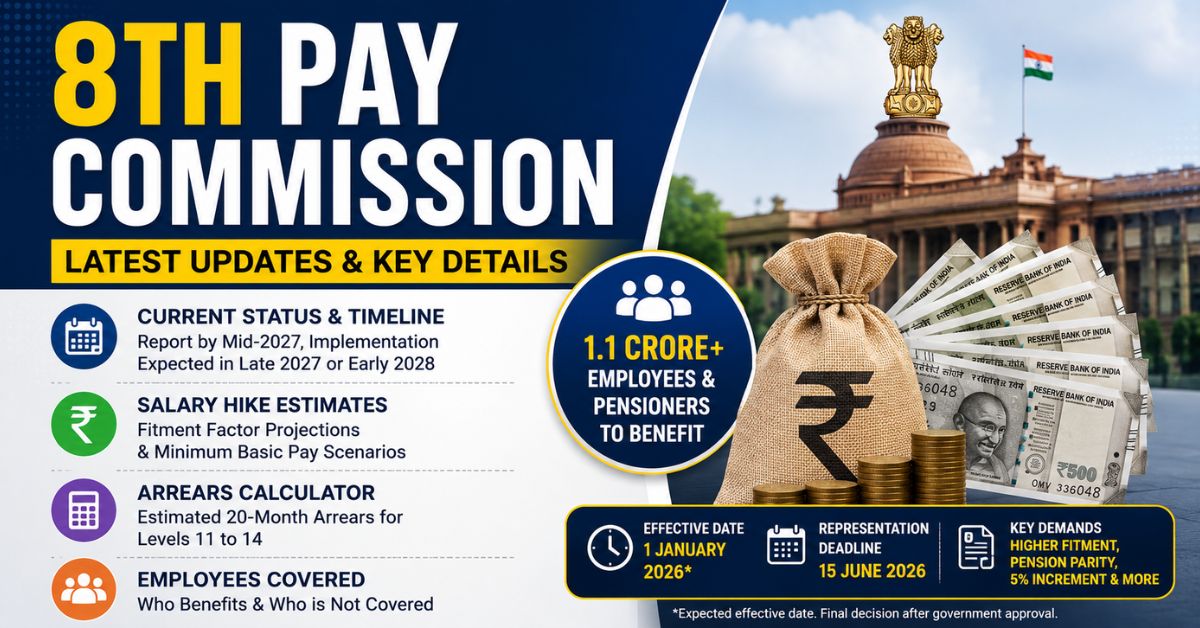
- The 8th Central Pay Commission is currently in the consultation phase and is reviewing salary, allowance, and pension structures.
- More than 1.1 crore central government employees and pensioners are expected to be impacted by its recommendations.
- Employee unions are demanding a higher fitment factor, improved pension parity, and enhanced annual increments.
- Several salary and arrears projections are circulating, but no official fitment factor or revised pay matrix has been announced.
- The commission is expected to submit its report in 2027, with implementation likely after government approval.
The 8th Central Pay Commission (8th CPC) has become one of the most closely watched developments for central government employees and pensioners across India. With more than 1.1 crore beneficiaries expected to be affected by its recommendations, discussions around salary revisions, pension updates, fitment factors, and arrears have intensified in recent months.
The commission is currently consulting employee unions, pensioner associations, and various stakeholders before preparing its final recommendations. While many salary projections and arrears calculations have gained attention online, the commission has not yet finalized any recommendations.
As a result, employees and pensioners are keenly watching developments to understand how future pay revisions may affect their earnings and retirement benefits.
8th Pay Commission India Current Scenario
The Union Government has approved the Terms of Reference (ToR) for the 8th Central Pay Commission and tasked it with reviewing the salary, allowance, and pension framework for central government employees and pensioners.
The commission has been given an 18-month timeline to complete its work and submit recommendations to the government. During this period, it is collecting suggestions and representations from stakeholders across the country.
One of the major recent developments was the extension of the deadline for memorandum submissions through the official portal until June 15, 2026. Employee organizations, pensioner groups, and various associations have used this opportunity to raise concerns and suggest reforms.
The consultation process is expected to play a significant role in shaping the final recommendations submitted by the commission.
Why the 8th Pay Commission Matters
Every Central Pay Commission influences the financial structure of government service for years. Beyond salary revisions, it reviews allowances, pension calculations, promotion-related issues, and other employment benefits.
The recommendations can affect:
- Basic pay structures
- Dearness Allowance integration
- House Rent Allowance (HRA)
- Transport Allowance (TA)
- Medical benefits
- Pension and family pension structures
- Career progression and pay matrix issues
For millions of employees and pensioners, these recommendations have a direct impact on long-term financial planning.
Expected Timeline for the 8th Pay Commission
Although the commission is actively working, several stages remain before revised salaries are implemented.
| Event | Expected Timeline |
|---|---|
| Start of 8th CPC Work | 2025 |
| Consultation Phase | Ongoing During 2026 |
| Final Representation Deadline | June 15, 2026 |
| Expected Report Submission | Mid-2027 |
| Government Review | 2027 |
| Cabinet Approval | Post Report Submission |
| Estimated Implementation | Late 2027 or Early 2028 |
Many analysts believe revised pay structures may eventually be implemented retrospectively from January 1, 2026. However, this remains an expectation rather than an official decision.
Understanding the Fitment Factor
The fitment factor is one of the most important elements of every Pay Commission.
It acts as a multiplier that converts an employee’s existing basic pay into a revised pay structure.
For example, if the current basic pay is ₹18,000 and a fitment factor of 2.57 is applied, the revised basic pay would become ₹46,260.
The final fitment factor has not yet been decided, but multiple proposals are being discussed by employee unions and financial experts.
Estimated Minimum Basic Pay Under Different Fitment Factors
| Fitment Factor | Estimated Minimum Basic Pay |
|---|---|
| 1.92 | ₹34,560 |
| 2.57 | ₹46,260 |
| 2.86 | ₹51,480 |
| 3.00 | ₹54,000 |
| 3.68 | ₹66,240 |
These figures are projections based on various fitment factor scenarios and should not be treated as official recommendations.
Major Demands Raised Before the Commission
Employee organizations and pensioner associations have submitted several demands during the consultation process.
- Higher fitment factor for salary revision
- Increase in annual increments from 3 percent to 5 percent
- Resolution of pay matrix anomalies
- Stronger pension parity mechanisms
- Improved medical, education, and related allowances
Many unions argue that rising living costs justify a more substantial revision than previous pay commission exercises.
Estimated 8th Pay Commission Salary Arrears Calculator for Levels 11 to 14
One of the biggest areas of interest among employees is the possibility of arrears if implementation occurs after the effective date.
The following projections assume a hypothetical 20-month implementation delay and are intended only for illustration purposes.
Level 11 Salary Arrears Estimate
| Fitment Factor | Revised Basic Pay | Monthly Increase | Estimated 20-Month Arrears |
|---|---|---|---|
| 2.00 | ₹1,35,400 | ₹67,700 | ₹13,54,000 |
| 2.15 | ₹1,45,555 | ₹77,855 | ₹15,57,100 |
| 2.28 | ₹1,54,356 | ₹86,656 | ₹17,33,120 |
| 2.57 | ₹1,73,989 | ₹1,06,289 | ₹21,25,780 |
| 2.86 | ₹1,93,622 | ₹1,25,922 | ₹25,18,440 |
Level 12 Salary Arrears Estimate
Current Basic Pay: ₹78,800
Level 13 Salary Arrears Estimate
Current Basic Pay: ₹1,23,100
Level 14 Salary Arrears Estimate
Current Basic Pay: ₹1,44,200
Across these levels, estimated arrears increase significantly as the fitment factor rises. However, actual payouts will depend on the final recommendations, implementation date, revised pay matrix, and government approval.
Which Employees Are Covered Under the 8th Pay Commission?
The 8th Central Pay Commission primarily covers employees and pensioners working under the Union Government.
Central Government Civil Employees
This category includes Group A, Group B, and Group C employees working in ministries, departments, and various central government organizations.
All India Services
The commission covers officers belonging to the Indian Administrative Service (IAS), Indian Police Service (IPS), and Indian Forest Service (IFS).
Railway Employees
Indian Railways employees are among the largest groups expected to benefit from future pay revisions.
Postal Department Employees
Employees of India Post and related postal services are also covered under central pay structures.
Defence Personnel
The recommendations will impact serving personnel in the Indian Army, Indian Navy, and Indian Air Force.
Central Armed Police Forces
Personnel from BSF, CRPF, CISF, ITBP, and SSB are also expected to be covered.
Central Government Pensioners and Family Pensioners
The commission reviews pension structures for retired employees and eligible family pension beneficiaries.
Who Is Not Directly Covered?
State government employees, public sector bank employees, and most PSU employees are generally not directly covered by the Central Pay Commission. These groups typically follow separate wage revision mechanisms.
What Happens Next?
The next major step is the completion of the consultation process and examination of representations submitted by stakeholders. After reviewing feedback from employees, pensioners, and organizations, the commission will prepare its final recommendations.
Once submitted, the report will undergo government review before being placed before the Union Cabinet for approval.
Until official recommendations are released, salary calculators, fitment factor projections, and arrears estimates should be viewed as illustrative scenarios rather than confirmed outcomes. The final recommendations of the 8th Central Pay Commission will ultimately determine how salaries, pensions, and allowances change for more than 1.1 crore beneficiaries across India.