


NTC Announced with Early-Stage Impact
- NVIDIA showcased Neural Texture Compression at GTC and GDC 2026
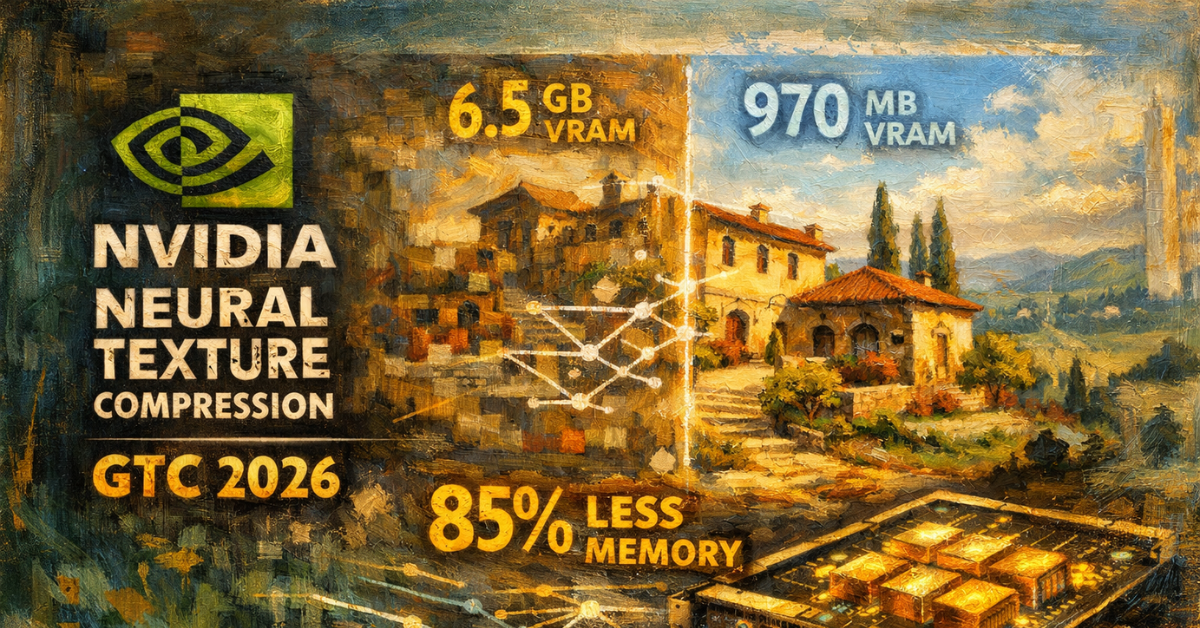
- Technology reduces texture memory usage by up to 85% in demos
- Neural Materials introduced to improve rendering efficiency
- RTXNTC SDK released for developers in early-stage access
- No commercial game adoption yet; real-world impact still under evaluation
NVIDIA presented updated developments in its Neural Texture Compression (NTC) technology at GTC 2026 and GDC 2026, outlining a new approach to reducing memory usage in modern game graphics. The technology remains in an early stage of adoption, with tools now being made available to developers.
NTC replaces traditional texture storage methods, which rely on large image files, with a compact mathematical format. During rendering, these textures are reconstructed in real time using small neural networks, allowing the system to display detailed visuals without storing full-resolution images in memory.
Demonstration Highlights Memory Reduction
In one of its primary demonstrations, NVIDIA presented a detailed “Tuscan Villa” scene to compare memory usage. Using conventional compression methods, the scene required approximately 6.5 GB of graphics memory. With NTC, the same scene was rendered at comparable visual quality using around 970 MB.
The company positioned this as an example of how texture data could be handled more efficiently, particularly as asset sizes continue to increase in modern game development. However, these results are based on controlled demonstrations rather than commercial game environments.
Neural Materials Extend the Approach
Alongside NTC, NVIDIA introduced “Neural Materials,” which aims to simplify how games process lighting and surface properties. Traditional rendering uses multiple texture layers to represent characteristics such as color, roughness, and reflectivity.
In NVIDIA’s demonstrations, these layers were compressed into fewer channels and processed through neural models. The company reported rendering speed improvements in test scenes, though performance may vary depending on implementation and hardware conditions.
Developer Tools Released in Early Form
NVIDIA has released the RTXNTC software development kit, allowing developers to begin experimenting with the technology. The SDK supports modern graphics standards such as DirectX 12 and Vulkan.
The company indicated that the system is designed to take advantage of dedicated hardware, including Tensor Cores, to handle the additional computation required for real-time reconstruction. As of now, the technology has not been adopted in released commercial titles.
Potential Impact Remains Under Evaluation
NTC could reduce the amount of memory required to store and render textures, which may help address current constraints in graphics hardware. It may also contribute to smaller game file sizes if widely implemented.
However, its practical impact will depend on how developers integrate the system into production workflows and how it performs across a range of real-world scenarios. Broader adoption across the industry, including support from other hardware vendors such as AMD and Intel, remains uncertain at this stage.
Early Stage in a Longer Transition
NVIDIA emphasized that Neural Texture Compression is a deterministic system and does not generate new visual content. Instead, it reconstructs textures based on existing data.
With the technology still in early access for developers, its long-term role in game development will become clearer as testing expands and early implementations begin to emerge. For now, it represents a potential shift in how graphical data may be stored and processed, rather than an immediate change in current gaming experiences.