


IND W vs PAK W: Key Highlights
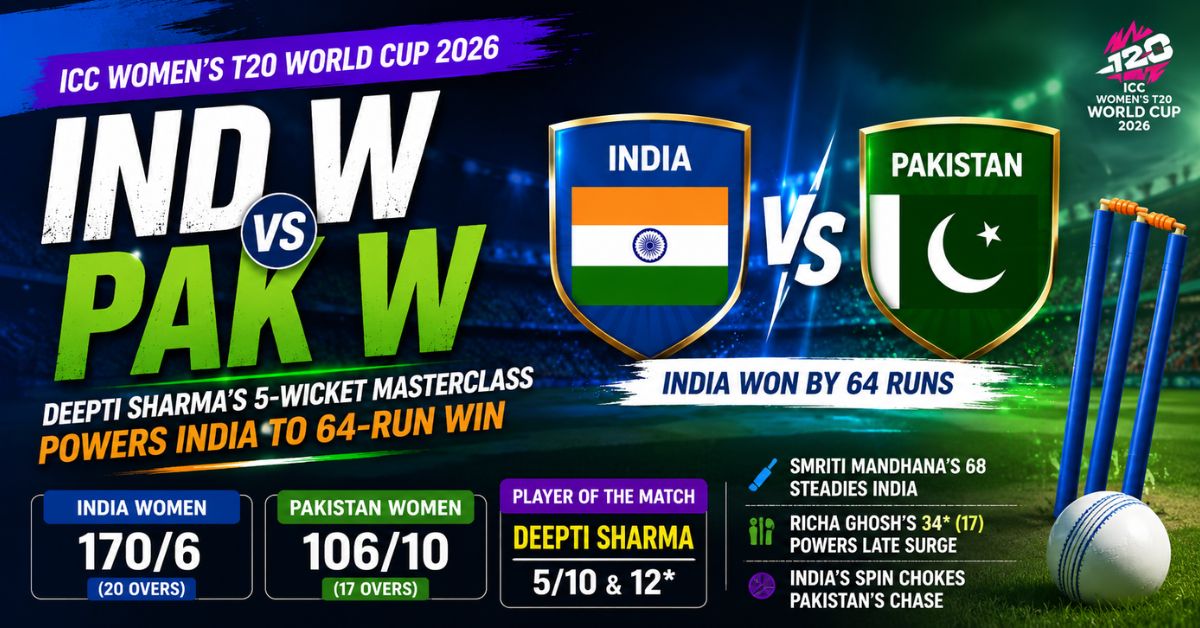
- India Women began their ICC Women’s T20 World Cup 2026 campaign with a dominant 64-run victory over Pakistan Women at Edgbaston.
- Smriti Mandhana scored 68 off 44 balls and shared a crucial 91-run partnership with Harmanpreet Kaur after India slipped to 18/2.
- Richa Ghosh’s unbeaten 34 off 17 balls helped India post a competitive total of 170/6 in 20 overs.
- Pakistan reached 52/1 in the Powerplay but lost momentum after Muneeba Ali’s dismissal and eventually collapsed for 106.
- Deepti Sharma delivered a match-winning spell of 5/10 and was named Player of the Match.
India Women made a powerful start to their ICC Women’s T20 World Cup 2026 campaign with a comprehensive 64-run victory over Pakistan Women at Edgbaston. After recovering from early trouble with the bat, the Women in Blue produced a complete team performance that highlighted their depth, experience, and ability to handle pressure on the biggest stage.
Vice-captain Smriti Mandhana led India’s recovery with a brilliant half-century, Richa Ghosh provided the late acceleration, and Deepti Sharma delivered one of the finest bowling performances of the tournament with a stunning five-wicket haul. The result gave India two important points and a major boost to their Net Run Rate in Group A.
While Pakistan showed promise during the Powerplay of their chase, India’s spin attack eventually took complete control as the innings collapsed dramatically.
IND W vs PAK W Match Summary
| Details | Score |
|---|---|
| Tournament | ICC Women’s T20 World Cup 2026 |
| Venue | Edgbaston, Birmingham |
| India Women | 170/6 (20 overs) |
| Pakistan Women | 106 all out (17 overs) |
| Result | India won by 64 runs |
| Player of the Match | Deepti Sharma (5/10 and 12*) |
Scorecard
India Women Innings
| Batter | Runs | Balls |
|---|---|---|
| Smriti Mandhana | 68 | 44 |
| Harmanpreet Kaur | 36 | 35 |
| Richa Ghosh | 34* | 17 |
| Deepti Sharma | 12* | 8 |
| Others | 20 | – |
| Extras | 0 | – |
| Total | 170/6 | 20 Overs |
Pakistan Women Innings
| Batter | Runs | Balls |
|---|---|---|
| Muneeba Ali | 41 | – |
| Others | 65 | – |
| Total | 106 All Out | 17 Overs |
India Women Bowling
| Bowler | Overs | Runs | Wickets |
|---|---|---|---|
| Deepti Sharma | 4 | 10 | 5 |
| Other Bowlers | 13 | 96 | 5 |
India Face Early Trouble
The match did not begin according to India’s plans. Pakistan’s bowlers struck twice in the early stages, removing Shafali Verma and Jemimah Rodrigues cheaply.
At 18 for 2, India found themselves under pressure. Pakistan had managed to expose India’s top order and briefly gained control of the contest.
However, experienced teams often find ways to recover, and India did exactly that through Smriti Mandhana and captain Harmanpreet Kaur.
The pair calmly rebuilt the innings without taking unnecessary risks. They focused on rotating strike, punishing loose deliveries, and ensuring that Pakistan could not build further pressure through wickets.
Their partnership changed the entire direction of the match.
Smriti Mandhana Leads the Recovery
Mandhana once again showed why she remains one of the most dependable batters in world cricket.
Walking in during a difficult phase, she absorbed the pressure and gradually shifted momentum back in India’s favor. Her innings combined patience with attacking intent, allowing India to recover while maintaining a healthy scoring rate.
Mandhana reached 68 runs from just 44 deliveries, striking nine boundaries and two sixes. Her timing was exceptional throughout the innings, and she consistently found gaps in the field.
More importantly, she ensured that India did not lose additional wickets during the crucial middle overs.
Her partnership with Harmanpreet Kaur was worth 91 runs and proved to be the foundation of India’s eventual total.
The innings demonstrated not only Mandhana’s skill but also her ability to perform when the team needs stability.
Harmanpreet Kaur Provides Valuable Support
While Mandhana grabbed most of the attention, Harmanpreet’s contribution was equally important.
The Indian captain scored 36 runs from 35 balls and played a responsible innings during the rebuilding phase. Rather than trying to dominate immediately, she allowed Mandhana to take the lead while ensuring that India continued moving forward.
Harmanpreet’s experience was evident as she helped manage the innings after the early wickets.
The captain’s knock also carried additional significance as she surpassed Mithali Raj to become India’s highest run-scorer in Women’s T20 World Cup history.
It was another milestone in an already remarkable international career.
Richa Ghosh Delivers the Finishing Touch
India’s innings had been rebuilt successfully, but the final overs would determine whether the total was merely competitive or truly challenging.
That responsibility fell to wicketkeeper-batter Richa Ghosh.
She responded with a superb late assault that completely changed the mood of the match.
Ghosh scored an unbeaten 34 from only 17 deliveries and maintained a strike rate of 200. Her aggressive approach ensured that Pakistan’s bowlers could not settle during the death overs.
The boundaries came regularly, and the momentum quickly shifted in India’s favor.
A score that might have finished around 150 suddenly climbed to 170.
Those extra runs eventually proved crucial because Pakistan never came close to matching the target.
India Finish Strong at 170
By the end of their innings, India had posted 170 for 6 from 20 overs.
Considering their position at 18 for 2, it represented an excellent recovery.
The combination of Mandhana’s stability, Harmanpreet’s support, and Ghosh’s finishing power gave India a total that placed significant pressure on Pakistan.
Although the surface offered some assistance to batters, 170 was still a challenging target in a World Cup match.
India knew that early wickets would strengthen their position, while Pakistan needed a strong start to remain competitive.
Pakistan Begin the Chase Positively
Pakistan’s response surprised many observers.
Despite losing an early wicket, they produced one of their best Powerplay performances against India in Women’s T20 Internationals.
The batters attacked from the beginning and found boundaries regularly. India’s fielding also appeared unusually untidy during the opening overs, allowing Pakistan to capitalize.
By the end of the Powerplay, Pakistan had reached 52 for 1.
It was reportedly their highest Powerplay score against India in Women’s T20 International cricket.
At that stage, the contest still appeared open.
Pakistan needed approximately 119 runs from the remaining 14 overs, a difficult but achievable task if wickets were preserved.
Muneeba Ali played a major role in keeping the chase alive.
Muneeba Ali Gives Pakistan Hope
Muneeba Ali looked comfortable against both pace and spin during the early part of the innings.
She rotated strike effectively and punished scoring opportunities whenever they appeared.
Her innings of 41 runs provided Pakistan with a platform from which they could dream of a successful chase.
For a brief period, Pakistan appeared capable of challenging India’s target.
The partnership building around Muneeba created optimism in the Pakistan camp, and India’s bowlers faced increasing pressure.
However, the match was about to experience a dramatic turning point.
Deepti Sharma Changes the Match
The moment that altered the contest came through Deepti Sharma.
First, she produced a brilliant direct-hit run-out to dismiss the well-set Muneeba Ali.
The dismissal immediately shifted momentum.
Pakistan lost a batter who had looked capable of batting deep into the innings, and the pressure quickly increased on the remaining players.
What followed was a complete bowling masterclass.
Deepti used her experience, control, and variations to make scoring extremely difficult. Pakistan’s batters struggled to read her deliveries and found very few opportunities to attack.
The wickets began to fall regularly.
The required run rate climbed rapidly.
Confidence disappeared from Pakistan’s dressing room.
India’s Spinners Take Control
One of India’s greatest strengths in women’s cricket has been the quality of their spin attack, and that strength was fully visible at Edgbaston.
Once the field spread and the middle overs began, Pakistan found it increasingly difficult to score freely.
India’s bowlers squeezed the run flow from both ends.
Dot balls created pressure.
Risky shots resulted in wickets.
The chase gradually moved beyond Pakistan’s reach.
While Deepti led the attack, the support from the rest of the bowling unit ensured that Pakistan never regained momentum.
The disciplined bowling effort highlighted why India are considered one of the strongest teams in the competition.
Historic Bowling Figures from Deepti Sharma
Deepti finished with remarkable figures of 5 wickets for just 10 runs from her four overs.
It was one of the standout performances of the tournament and a reminder of her importance to India’s plans.
Taking five wickets in a T20 World Cup match is a rare achievement.
Doing so while conceding only ten runs makes the performance even more impressive.
Her spell combined accuracy, patience, and tactical awareness.
Pakistan’s batters repeatedly struggled to find scoring opportunities against her.
Every wicket further increased India’s control of the match.
By the end of the innings, Deepti had firmly established herself as the game’s defining performer.
Her all-round contribution was also notable, as she remained unbeaten on 12 runs during India’s innings before producing the decisive bowling spell.
The Player of the Match award was a straightforward decision.
Pakistan Collapse Under Pressure
The most striking aspect of Pakistan’s innings was the contrast between the start and the finish.
After reaching 52 for 1 during the Powerplay, they appeared well positioned to compete.
However, once Muneeba departed and India’s spinners tightened their grip, the collapse began.
Pakistan eventually lost their final nine wickets for just 54 runs.
The innings ended at 106 all out in only 17 overs.
The collapse reflected both India’s outstanding bowling and Pakistan’s inability to build partnerships during the middle overs.
Every time a batter looked capable of settling, India found a breakthrough.
The pressure never eased.
What the Result Means for Group A
The victory gives India a valuable start in one of the tournament’s most competitive groups.
Group A includes Australia, Bangladesh, Pakistan, South Africa, and the Netherlands.
With only a limited number of matches available, every point matters.
India’s convincing margin of victory also significantly improved their Net Run Rate, which could prove important later in the group stage.
Following the opening round of matches, Australia occupied the top position in Group A with a Net Run Rate of +3.250.
India followed closely in second place with a Net Run Rate of +3.200.
Bangladesh also secured a victory and remained in contention.
Pakistan, South Africa, and the Netherlands began their campaigns with defeats.
Group A Standings
| Position | Team | Matches | Wins | Losses | NRR | Points |
|---|---|---|---|---|---|---|
| 1 | Australia Women | 1 | 1 | 0 | +3.250 | 2 |
| 2 | India Women | 1 | 1 | 0 | +3.200 | 2 |
| 3 | Bangladesh Women | 1 | 1 | 0 | +0.407 | 2 |
| 4 | Netherlands Women | 1 | 0 | 1 | -0.407 | 0 |
| 5 | Pakistan Women | 1 | 0 | 1 | -3.200 | 0 |
| 6 | South Africa Women | 1 | 0 | 1 | -3.250 | 0 |
A Statement Start from India
Major tournaments are often defined by strong starts, and India could hardly have asked for a better opening performance.
They overcame early batting pressure, built a competitive total, handled a challenging phase during Pakistan’s chase, and then completely dominated the closing stages of the match.
The victory showcased multiple strengths within the squad.
Mandhana provided composure when wickets fell early.
Harmanpreet guided the recovery.
Richa delivered explosive finishing power.
Deepti produced a match-winning bowling display.
Together, those contributions created a complete team performance.
For India, the result provides confidence, momentum, and a valuable Net Run Rate advantage as they continue their Women’s T20 World Cup 2026 campaign. For Pakistan, the challenge now will be to recover quickly and address the middle-order collapse that transformed a promising chase into a heavy defeat.
On the opening weekend of the tournament, however, the spotlight belonged firmly to India and especially to Deepti Sharma, whose extraordinary five-wicket spell helped launch the Women in Blue’s World Cup journey in commanding fashion.