


Key Takeaways
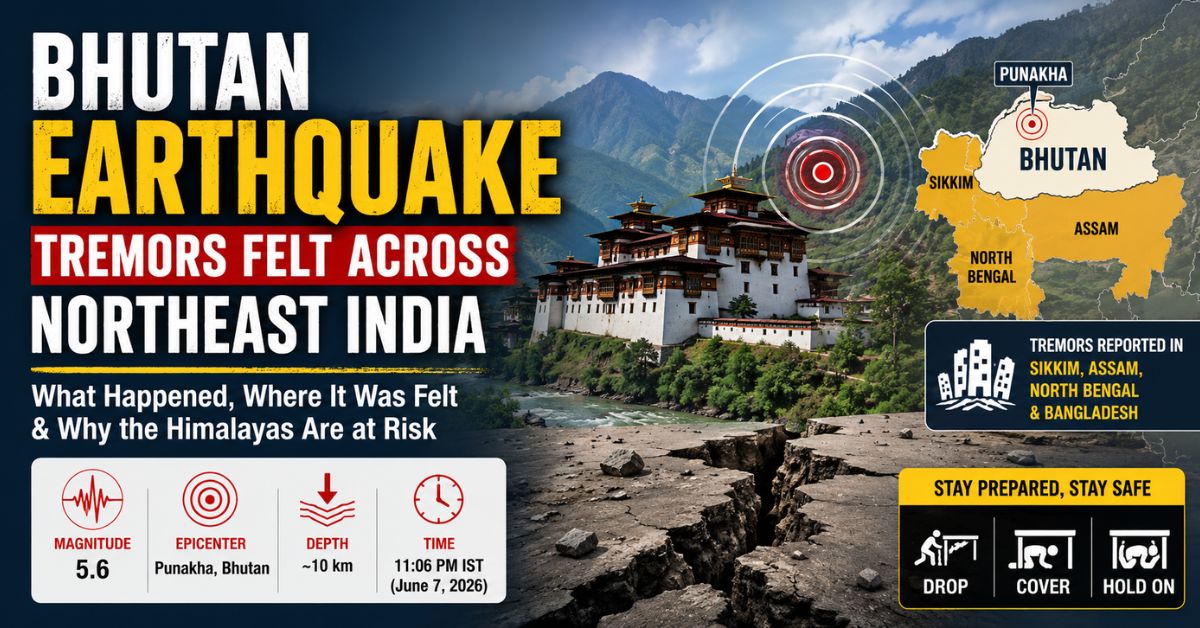
- Reports indicated a 5.6-magnitude earthquake struck near Punakha, Bhutan, late on June 7, prompting concern across the eastern Himalayan region.
- Tremors were reportedly felt in parts of Bhutan, Sikkim, Assam, North Bengal, and Bangladesh.
- No immediate reports of major casualties, widespread structural damage, or infrastructure collapse emerged following the event.
- Experts note that shallow earthquakes can produce stronger shaking near the epicenter despite having moderate magnitudes.
- The incident highlights the continuing earthquake risks associated with the active Himalayan tectonic zone.
Reports of an earthquake in Bhutan late on June 7 have drawn attention to the earthquake risks faced by communities across the Himalayan region. According to information circulating through regional monitoring channels and local reports, a magnitude 5.6 earthquake was reported near Punakha, Bhutan, at around 11:06 PM IST. Tremors were reportedly felt in several neighboring areas, including parts of Northeast India and Bangladesh.
At the time of publication, some details surrounding the event were still awaiting confirmation from major seismic monitoring agencies. Nevertheless, the reports have once again highlighted the vulnerability of Himalayan communities to earthquakes and the importance of preparedness in one of the world’s most active seismic regions.
Reports Suggest Moderate Earthquake Near Punakha
Initial reports suggested that the earthquake measured 5.6 on the Richter scale and originated near Punakha, a district in western Bhutan known for its mountainous landscape and river valleys.
The earthquake was reportedly shallow, occurring at a depth of around 10 kilometers below the Earth’s surface. Shallow earthquakes are often felt more strongly because seismic waves reach the ground with less energy loss.
Residents in several locations reportedly experienced shaking that lasted for a few seconds. In many areas, people moved outdoors as a precaution after feeling the tremors.
Although earthquakes of this magnitude can sometimes cause localized damage, there were no immediate reports of major casualties, building collapses, or widespread destruction in the hours following the event.
Areas Where Tremors Were Reportedly Felt
The reported earthquake was not limited to Bhutan. Residents in neighboring regions also described experiencing noticeable shaking.
Among the Indian states where tremors were reportedly felt were Sikkim and Assam. People in North Bengal, including areas around Siliguri, Jalpaiguri, and Cooch Behar, also reported feeling the movement.
Because these regions are geographically close to Bhutan and share similar geological conditions, it is common for earthquakes occurring in Bhutan to be felt across state and national borders.
| Region | Reported Impact |
|---|---|
| Punakha, Bhutan | Reported epicenter area where strongest shaking was likely experienced |
| Sikkim | Residents reported feeling tremors |
| Assam | Mild tremors reportedly felt in several locations |
| North Bengal | Reports of noticeable shaking from residents |
| Bangladesh | Some residents reported experiencing tremors |
While such cross-border effects are common during Himalayan earthquakes, the intensity experienced by residents can vary depending on distance from the epicenter, local soil conditions, building structures, and earthquake depth.
Delhi-NCR Was Not Among the Most Affected Areas
Questions quickly emerged online about whether the Bhutan earthquake was responsible for shaking reported in Delhi-NCR.
Based on available information, there were no major reports indicating that the Bhutan earthquake produced strong tremors in Delhi and surrounding areas. The large distance between Bhutan and the National Capital Region makes strong shaking less likely from a moderate earthquake of this scale.
Experts note that while large earthquakes can sometimes be felt hundreds of kilometers away, the strength of shaking generally decreases with increasing distance from the epicenter.
Recent Seismic Activity Has Kept Northern India Alert
The reported Bhutan earthquake comes shortly after another period of seismic activity that attracted attention across northern India.
Earlier in June, earthquake tremors were reportedly felt across parts of northern India following seismic activity associated with the Hindu Kush region and nearby mountainous areas. The Hindu Kush is one of Asia’s most active earthquake zones and regularly generates earthquakes that are felt across multiple countries.
Residents in cities across northern India frequently experience tremors originating from this region due to the geological characteristics of the mountain belt stretching across South and Central Asia.
Why Earthquakes Are Common in the Himalayas
The Himalayan mountain range exists because the Indian Plate continues to collide with the Eurasian Plate. This process began millions of years ago and continues today.
As the Indian Plate slowly moves northward, enormous pressure builds beneath the Earth’s surface. Eventually, this pressure is released through faults and fractures, creating earthquakes.
Scientists consider the Himalayan region one of the most active continental collision zones in the world. Countries including Bhutan, India, Nepal, Pakistan, and China regularly experience earthquakes linked to these ongoing tectonic processes.
The same geological forces that created the Himalayas continue to shape the region today, making earthquakes a natural and recurring phenomenon.
Why Shallow Earthquakes Can Feel More Intense
Earthquake depth is one of the most important factors influencing how strongly people experience shaking.
Shallow earthquakes occur relatively close to the Earth’s surface. Because the seismic waves travel a shorter distance before reaching populated areas, the shaking can feel stronger and more sudden.
If the reported Bhutan earthquake occurred at a depth of around 10 kilometers, that shallow depth would help explain why residents in nearby regions described the tremors as highly noticeable despite the earthquake being of moderate magnitude.
| Earthquake Factor | Effect on Shaking |
|---|---|
| Magnitude | Determines overall energy released |
| Depth | Shallow earthquakes often feel stronger near the epicenter |
| Distance | Shaking generally weakens with distance |
| Ground Conditions | Soft soils can amplify tremors |
Preparedness Remains a Priority for Communities
Events such as the reported Bhutan earthquake serve as reminders that preparedness remains essential for communities living in earthquake-prone regions.
Experts recommend maintaining emergency supplies, identifying safe locations inside homes and workplaces, and understanding local emergency procedures.
During an earthquake, people are generally advised to remain calm, protect their head and neck, and stay away from windows, glass panels, and objects that could fall.
If indoors, individuals should take shelter under sturdy furniture whenever possible. If outdoors, they should move away from buildings, utility poles, and other structures that may pose risks.
- Drop to the ground when shaking begins.
- Take cover under sturdy furniture.
- Hold on until the shaking stops.
- Stay away from windows and falling objects.
- Be prepared for possible aftershocks.
Monitoring and Verification Continue
Earthquake information often evolves during the hours following an event as scientists analyze data from seismic monitoring stations.
Magnitude, depth, and epicenter location can sometimes be revised after additional information becomes available. For this reason, experts encourage the public to rely on official updates from recognized seismic agencies and disaster management authorities.
Accurate reporting helps authorities assess risks, coordinate emergency responses, and provide reliable information to communities that may be affected.
A Reminder of the Region’s Geological Reality
The attention surrounding the reported Bhutan earthquake reflects the broader reality faced by communities throughout the Himalayan region. From Bhutan and Nepal to northern India and beyond, millions of people live in areas shaped by powerful geological forces.
Most earthquakes pass without causing major damage, but every seismic event serves as a reminder of the need for preparedness, scientific monitoring, and resilient infrastructure.
As researchers continue studying seismic activity across the Himalayas, governments and local communities face the ongoing challenge of reducing risk while adapting to life in one of the world’s most dynamic geological environments.